Home / Insights / Strip projects
Las Vegas Strip · Landmark LED
The biggest LED projects in Las Vegas, and what they teach anyone planning the next one
From the Sphere's 580,000-square-foot Exosphere to the Fremont Street canopy and the Strip's newest marquees, here is how the city's landmark LED projects were built, by the numbers, and the lessons owners, architects and contractors can take into their own.
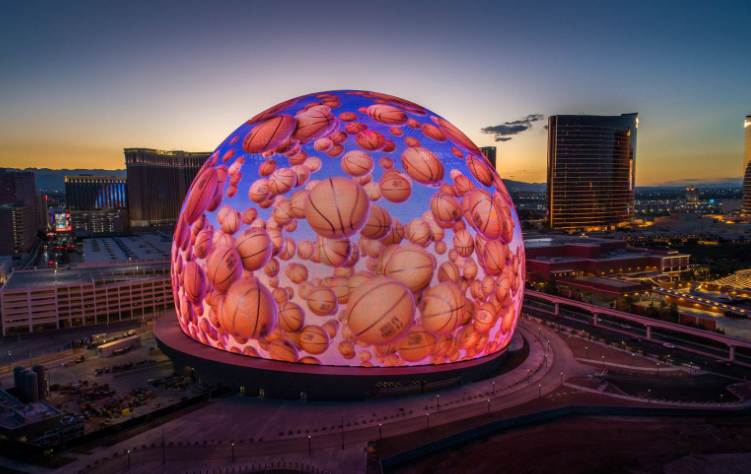
The biggest LED projects in Las Vegas are not just big screens. They are some of the most complex lighting and display builds anywhere: the Sphere's Exosphere covers 580,000 square feet with roughly 1.2 million LED pucks, the Fremont Street Experience canopy stretches about 1,375 feet over a pedestrian mall, and Resorts World wrapped a hotel tower in a 100,000-square-foot LED screen. Each one solved problems of scale, heat, structure, access and control that every large LED project in this city has to solve.
Quick answer
The landmark LED projects in Las Vegas include the Sphere's Exosphere (580,000 sq ft, about 1.2 million LED pucks), the $32 million Viva Vision canopy upgrade on Fremont Street (about 16.4 million pixels at up to 5,000 nits), the 100,000 sq ft LED facade at Resorts World, Circa's 68-foot programmable LED sign, the 167-foot three-sided marquee at Fontainebleau and the Al Davis Memorial Torch at Allegiant Stadium, built from more than 3,200 LED light bars. Next up: a $1.75 billion ballpark and a $4 billion Hard Rock resort.
We are a Las Vegas team that coordinates design-assist, supply and licensed installation for large LED lighting, signage and display projects. We did not build the projects below; they were delivered by the owners, manufacturers and contractors named in the public reporting we cite at the end. We study them because they show, at the largest possible scale, what makes big LED work succeed here.
Why Las Vegas builds the world's most ambitious LED projects
Las Vegas has always used light as marketing. The neon era turned casino signs into landmarks; today, LED does the same job at a scale neon never could. A resort's exterior is now a programmable canvas that can run brand content, live events, sponsors and holiday shows, and in some cases sell advertising.
The conditions here also push the technology hard. Summer heat, intense sun, wind-blown dust and 24-hour operation punish components that would last for years elsewhere. Exteriors have to be bright enough to read in daylight and dim enough not to glare at night. And most properties never close, so installation and maintenance have to happen around live operations. That combination is why the Strip has become a proving ground for large-format LED.
The landmark LED projects in Las Vegas
1. The Sphere: the Exosphere, 580,000 square feet of LED
The Sphere at the Venetian Resort is the reference point for exterior LED anywhere. Its outer skin, the Exosphere, was first lit publicly on July 4, 2023, before the venue opened that September. According to reporting at the time, it is made of about 1.2 million LED pucks spaced eight inches apart, each containing 48 individual diodes, capable of 256 million colors, across a 580,000-square-foot surface on a structure 366 feet tall and 516 feet wide. The display was developed by Sphere Studios with LED specialist SACO Technologies.
Lesson: at large viewing distances, a coarse pixel spacing on a huge surface can deliver a stunning image. Pixel pitch should be chosen for how far away people actually are, not for a spec sheet.
2. Fremont Street Experience: the $32 million Viva Vision canopy
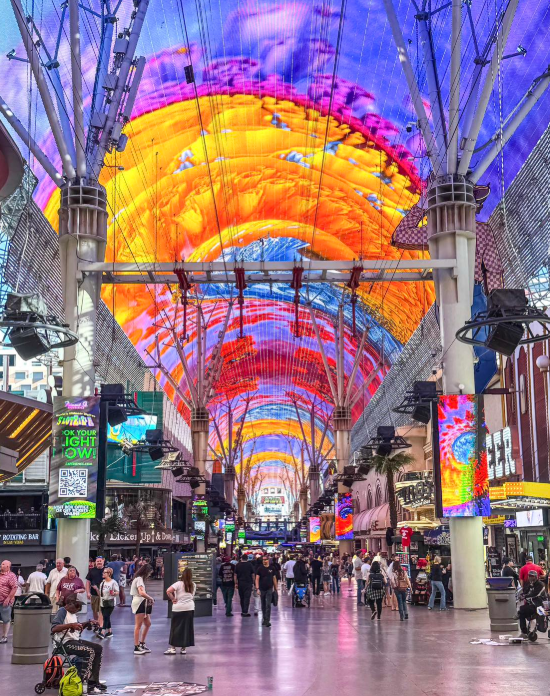
Downtown, the Fremont Street Experience canopy is one of the longest LED displays in the world. Its 2019 upgrade, a $32 million project, replaced the original screen with a new display about 1,375 feet long, mounted around 90 feet above the pedestrian mall. Reported specifications include about 16.4 million pixels, roughly four times the previous resolution, and a peak brightness of 5,000 nits, about seven times brighter than the screen it replaced, bright enough to run shows before dark.
The display was built by Watchfire, which won the contract over more than a dozen other bidders. Installation was carried out in sections by local Las Vegas companies, replacing the old screen row by row largely in the early morning so the attraction could stay open, with the full upgrade unveiled for New Year's Eve 2019.
Lesson: on a live property, phasing is the project. Sequencing work into overnight windows and sections is how big upgrades get done without closing the venue.
3. Resorts World Las Vegas: a 100,000-square-foot LED facade
Before Resorts World opened in the summer of 2021, it previewed something new for the Strip: a direct-view LED screen of about 100,000 square feet covering a face of the hotel tower, built from more than 3,500 LED cabinets. It first ran a digital fireworks show on July 4, 2020. The property later partnered with Clear Channel Outdoor on advertising for its LED walls, turning the facade into a media asset as well as a brand statement.
Lesson: a large LED facade can be a revenue line, not just a cost. Decide early whether the display will carry third-party advertising, because that affects content systems, contracts and permitting.
4. Circa Resort & Casino: a 68-foot programmable LED sign
Downtown's Circa, which opened on October 28, 2020, kept the Las Vegas sign tradition alive in LED form. Its "CIRCA" sign, manufactured by YESCO, spans 68 vertical feet, with a first "C" 34 feet tall, and weighs nearly six tons. More than 3,000 fully programmable RGB LEDs light the letters, and they connect to the resort's lighting control system. Fabrication took about four weeks and installation about three days.
Lesson: integrate signs with the property's lighting controls. When the sign, facade and site lighting share a control system, the whole exterior can run coordinated scenes and shows.
5. Fontainebleau Las Vegas: a 167-foot, three-sided marquee
The Fontainebleau tower on the north Strip opened in December 2023 after one of the longest construction stories in the city. In early 2024, its new marquee came to life: a 167-foot-tall, three-sided LED structure with two main displays facing north and south and a slim vertical display between them, supplied by display manufacturer Yaham.
Lesson: marquees are oriented to traffic. Multi-sided designs put the biggest faces toward the directions most viewers approach from, and that decision drives structure and cost.
6. Allegiant Stadium: the Al Davis Memorial Torch
Not every landmark LED project is a screen. At Allegiant Stadium, home of the Las Vegas Raiders, the Al Davis Memorial Torch is built from more than 3,200 LED light bars supplied by ClearLED, mounted on a superstructure on the stadium's mezzanine level and programmed to mimic the look and flicker of a real flame.
Lesson: LED is a sculptural medium. Some of the most memorable installations use linear and pixel products to create an object or effect rather than a rectangular display.
The projects side by side
| Project | Type | Reported scale | Key takeaway |
|---|---|---|---|
| Sphere Exosphere | Spherical LED exterior | 580,000 sq ft; ~1.2M pucks | Match pixel spacing to viewing distance |
| Fremont Street Viva Vision | LED canopy | ~1,375 ft long; ~16.4M pixels; $32M | Phase installs around live operations |
| Resorts World facade | Direct-view LED facade | ~100,000 sq ft; 3,500+ cabinets | Plan for advertising and content early |
| Circa sign | Programmable RGB sign | 68 ft tall; 3,000+ LEDs | Tie signs into lighting controls |
| Fontainebleau marquee | Three-sided LED marquee | 167 ft tall | Orient faces to traffic |
| Al Davis Memorial Torch | Sculptural LED | 3,200+ LED light bars | Use LED to build objects, not just screens |
The LED work you don't see from the boulevard
The headline projects get the attention, but most of the LED work inside a Las Vegas resort happens where passersby never look. Sportsbooks run some of the largest indoor video walls in any building type, with many sources on screen at once and viewers at very different distances. Casino floors use LED in decorative ceilings, coves and feature elements that have to run around the clock without flicker on camera. Ballrooms and convention spaces use LED walls that are reconfigured from one event to the next, and nightclubs and dayclubs combine show lighting, pixel elements and video in a single control system.
Behind the scenes, these systems share the same needs as the giant exteriors: correct pixel pitch for the viewing distance, power and data designed in from the start, heat management in enclosed spaces, service access that does not mean closing a revenue area, and a stock of spare modules so a failure is fixed overnight. They are also where many upgrade projects begin, as older displays and lighting reach the end of their life and replacement parts become hard to find. For owners, that steady cycle of interior upgrades often matters as much as the next marquee.
What's being built next
The pipeline of large projects means more LED work is coming. The Athletics broke ground on June 23, 2025, on a $1.75 billion ballpark of about 33,000 seats on the former Tropicana site, with a Mortenson-McCarthy joint venture as construction manager and opening planned for 2028. On the former Mirage site, Hard Rock's resort complex, reported at about $4 billion and featuring a 42-story guitar-shaped hotel tower, is scheduled to open in the second half of 2027.
Projects like these carry lighting, signage and display scopes worth getting right: facade and architectural lighting, exterior signs and marquees, interior video displays and venue lighting. Beyond the headline builds, there is a steady stream of renovations, rebrands and LED upgrades across existing resorts, downtown properties and off-Strip venues.
Planning a large LED project in Las Vegas?
We work with owners, architects and general contractors on resort lighting, marquees, facades and video walls, from design-assist to licensed installation and commissioning.
Seven lessons for owners, architects and contractors
- Bring LED into design early. Structure, power, data and access for a facade or marquee have to be designed into the building. Added late, they cost more and compromise the result. See our guide to facade lighting and new-build packages.
- Specify for the desert. Heat, UV and dust ratings, brightness for daylight readability and automatic dimming at night are not optional here.
- Choose pixel pitch by viewing distance. As the Sphere shows, the right pitch for a building-scale display can be far coarser than for a lobby wall. Our video wall guide has a quick reference.
- Plan phasing around operations. Viva Vision's row-by-row, early-morning installation is the model for upgrades on properties that never close.
- Integrate controls. Signs, facades and site lighting on a shared control strategy can run coordinated scenes, events and schedules.
- Decide the business model. If an exterior screen may carry advertising, plan the content system, contracts and permits from the start.
- Use licensed, insured contractors, and check their limits. In Nevada, contracting work requires a license from the Nevada State Contractors Board in the right classification (for example electrical or sign work), and each license carries a monetary limit that every bid must fall within.
Planning your own big LED project: a short checklist
- Purpose: brand statement, wayfinding, entertainment, advertising revenue, or all of these?
- Viewing distances: closest, typical and farthest viewers, which set pixel pitch and brightness.
- Structure: new or existing, wind loads, foundations, and engineering review.
- Power and data: dedicated circuits, surge protection and redundant data paths.
- Access: how every module, fixture and power supply will be serviced.
- Controls and content: who creates content, how it is scheduled, and how it connects to existing systems.
- Permits: sign, electrical and building permits with Clark County or the relevant city.
- Spares: attic stock of modules and power supplies so failures are fixed in hours.
- Schedule: manufacturing lead times, delivery, installation windows and commissioning.
If you are planning a marquee or exterior sign, start with our page on LED marquee signs and large-format signage. For resort interiors and exteriors, see hotel and casino LED lighting.
Frequently asked questions
What is the biggest LED display in Las Vegas?
By surface area, the Sphere's Exosphere is the largest, at about 580,000 square feet covered by roughly 1.2 million LED pucks. The Fremont Street Experience canopy is one of the longest, at about 1,375 feet.
How many LEDs are on the Sphere in Las Vegas?
Reporting at launch described about 1.2 million LED pucks spaced eight inches apart, each with 48 individual diodes, on the 580,000-square-foot Exosphere.
How much did the Fremont Street canopy upgrade cost?
The Viva Vision upgrade completed in 2019 was a $32 million project, built by Watchfire and installed in sections by local Las Vegas companies.
How big is the LED screen at Resorts World?
About 100,000 square feet, built from more than 3,500 LED cabinets on the hotel tower. It was first switched on with a digital fireworks show on July 4, 2020.
What LED projects are coming to Las Vegas?
Major builds include the Athletics' $1.75 billion ballpark on the former Tropicana site, planned to open in 2028, and Hard Rock's roughly $4 billion resort with a 42-story guitar-shaped tower, scheduled for the second half of 2027, plus ongoing resort renovations and rebrands.
What license is needed to install LED signs in Nevada?
Contracting work in Nevada requires a license from the Nevada State Contractors Board. Sign work and electrical work have their own classifications, and every bid must fall within the contractor's monetary limit. Always confirm the installing contractor's license before awarding work.
How do you choose pixel pitch for an outdoor LED marquee?
Start from viewing distance. A common rule of thumb is that the closest comfortable viewing distance in feet is roughly 8 to 10 times the pixel pitch in millimeters. Outdoor marquees viewed from the street typically use coarser pitches than indoor walls.
Why do Las Vegas LED displays need such high brightness?
Outdoor displays have to be readable in direct desert sun. The Viva Vision upgrade, for example, was specified at up to 5,000 nits so shows can run before dark. Good systems dim automatically at night.
How early should LED be included in a new resort design?
As early as schematic design. Mounting, structure, power, data and access for facades, marquees and displays all need to be designed into the building to avoid costly changes later.
Related
Sources
- Inside Lighting, Largest LED screen on Earth lights up Las Vegas (July 2023).
- invidis / Sixteen:Nine, Viva Vision in Vegas starts getting facelift (April 2019); KTNV, Viva Vision to get 7x brighter.
- invidis / Sixteen:Nine, New Vegas casino resort previews giant 100,000 sq ft LED facade (July 2020); Billboard Insider, Clear Channel Outdoor partners with Resorts World Las Vegas.
- Signshop, Circa Resort & Casino completes installation of first exterior sign (July 2020).
- invidis / Sixteen:Nine, 167-foot-tall, three-sided marquee switches on at Fontainebleau (March 2024).
- invidis / Sixteen:Nine, LED light strips create giant memorial torch at LV Raiders venue (July 2021).
- Construction Equipment Guide, A's break ground on $1.75B Vegas ballpark due in 2028; CDC Gaming, Hard Rock guitar-shaped hotel rising in Las Vegas.
- Nevada Administrative Code 624.200 and 624.240 (electrical and sign classifications); Nevada contractor's checklist.
Las Vegas LED Lights is independent and is not affiliated with the properties, manufacturers or contractors named in this article, and did not work on these projects. Figures are as reported by the sources above at the time of publication. The Sphere and Fremont Street photographs show the projects described; the remaining image is an illustration.