Home / Insights / Sportsbook video walls
Resorts & Casinos · Sportsbook LED
Sportsbook LED video walls in Las Vegas, sized for the seats, the feeds and the big games
How to plan a sportsbook LED video wall that works on the busiest Sunday of the season: viewing distance and pixel pitch, wall size and canvas resolution, multi-feed processing, odds boards, power, heat, service access and phasing on a floor that never closes.
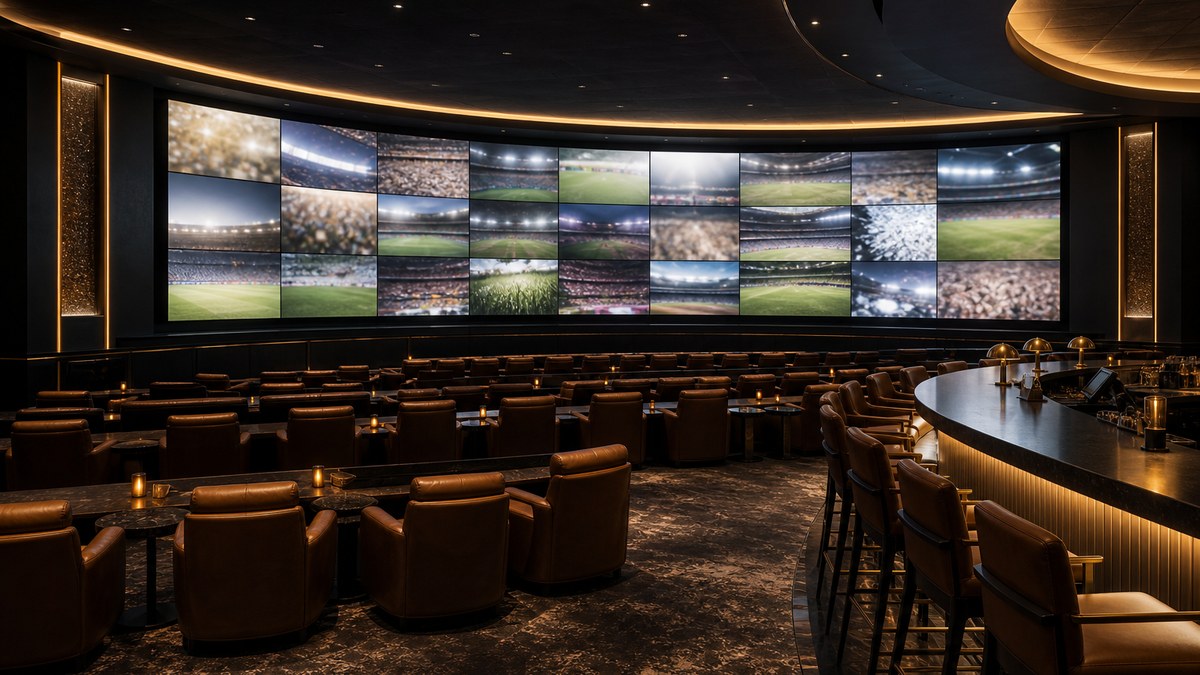
A sportsbook LED video wall in Las Vegas has to do something no other display in the building does: show a dozen or more live games, odds and racing at once, readable from the front row and the back bar, all day and all season, without a dark module on the biggest weekend of the year. The right wall starts with the seats, not the screen. Viewing distance sets pixel pitch, the number of simultaneous feeds sets the canvas size and processing, and the property's operating calendar sets when it can be built.
Quick answer
Size a sportsbook LED wall from the seating plan: pick pixel pitch from the closest regular viewing distance (a common rule of thumb is about 10 feet of distance per millimeter of pitch, so 2.5 mm suits viewers from roughly 25 feet back), then size the wall for the number of games shown at once. Landmark Las Vegas books use walls of roughly 4,000 to 4,500 square feet at about 2.5 mm, with tens of millions of pixels driven by multi-window processors. Plan structure, dedicated power, HVAC for the heat load, front or rear service access, spare modules and an off-season installation window from the start.
We are a Las Vegas team that coordinates design-assist, supply and licensed installation for large LED lighting, signage and display projects, including indoor and outdoor LED video walls. We did not build the sportsbooks described below. They were delivered by the operators, manufacturers and integrators named in the public reporting we cite at the end. We use them because they are the clearest public benchmarks for anyone planning a new or renovated book.
Why the sportsbook wall matters more than ever
Most sports wagering in Nevada now happens on phones. The Nevada Gaming Control Board has published mobile figures since January 2020, and in April 2025 mobile accounted for 78.1% of the state's sports betting handle, the highest non-pandemic share on record at the time, according to industry reporting. Over the first four months of 2025 the mobile share was about 70%.
That shift changed what a sportsbook is for. Guests do not need a counter to place a bet anymore; they come for the room. The book has become a viewing venue: a place to watch every game at once with a crowd, a drink and a good seat. The operators reinvesting in their books, from the Strip to Downtown to the locals market, are building around one thing above all, the LED wall. When the wall is right, the room fills on game days, food and beverage follow, and the space works as an event venue for watch parties and fights. When it is wrong (too coarse for the seats, too few windows, glare, a dark row of modules), guests watch on their phones somewhere else.
The Las Vegas benchmarks
A handful of public projects set the bar for what owners, designers and guests now expect. The figures below are as reported by the sources listed at the end.
Westgate SuperBook: the long curved wall
The Westgate Las Vegas SuperBook, a book of roughly 25,000 to 30,000 square feet that opened in 1986, was rebuilt around a curved LED wall about 20 feet tall and reported at 220 to 240 feet wide (sources differ), roughly 4,400 square feet. It was built from 1,640 Christie Velvet LED tiles at 2.5 mm pitch for more than 65 million pixels, working with integrator HB Communications and RP Visual Solutions, which fabricated the mounting structure. A curved bar of about 100 feet follows the shape of the screen, and the seating was designed so every seat has a front-row view.
Lesson: a very long, relatively low wall lets a large room share one canvas. The architecture (curved bar, tiered seating) is designed around the screen, not the other way around.
Circa: a three-story canvas built for many games at once
Circa Resort & Casino in Downtown Las Vegas opened in late 2020 with a three-level sportsbook described by its display manufacturer, Daktronics, as home to the world's largest sportsbook LED video wall. Reporting on the processing describes the main wall as about 118 by 38 feet at 2.5 mm pitch, more than 66 million pixels, with an adjacent main odds board of about 42 by 23 feet at 3.9 mm and a smaller second-floor odds board at 1.9 mm. Up to 24 events can run at once, and staff resize and rearrange windows from a touch panel through a control system integration. The room seats about 1,000 viewers across stadium seating, a lounge and private boxes.
Lesson: different surfaces in the same room deserve different pitches. The main wall, the odds boards and the close-up second-floor display each match the distance people actually view them from.
Durango and Sunset Station: the locals-market model
Station Casinos' Durango, which opened in December 2023 in the southwest valley, put more than 4,200 square feet of LED across six screens into a 10,000-square-foot sportsbook, including what the company described as a first double-sided center-hung LED display, so the room reads from every side. In May 2024 Sunset Station in Henderson unveiled a renovated amphitheater-style sportsbook built around a 152-foot panoramic LED wall that can show up to 30 feeds at once, described by the property as a larger version of the Durango design.
Lesson: once an operator proves a format at a new property, it rolls out across the portfolio. A good first design becomes a standard, which is why getting the first one right matters.
The benchmarks side by side
| Sportsbook | Reported LED scale | Pitch | Key takeaway |
|---|---|---|---|
| Westgate SuperBook | ~20 ft tall, 220–240 ft wide; 65M+ pixels | 2.5 mm | Design the room around one long canvas |
| Circa | ~118 × 38 ft main wall; 66M+ pixels; 24 events | 2.5 / 3.9 / 1.9 mm | Match each surface to its viewing distance |
| Durango | 4,200+ sq ft across six screens | Not reported | Center-hung, double-sided for 360° viewing |
| Sunset Station | 152 ft panoramic wall; up to 30 feeds | Not reported | Amphitheater seating built to the wall |
Step 1: start from the seats, then choose pixel pitch
Pixel pitch is the distance between the centers of neighboring pixels, in millimeters. Smaller pitch means more pixels per square foot, a finer image up close and a larger processing and product scope. The right pitch is the coarsest one that still looks seamless from the closest seat that matters.
Two rules of thumb are widely used in the display industry. The simple one, the 10x rule, says pixel pitch in millimeters multiplied by 10 gives an approximate minimum viewing distance in feet. The stricter one, visual acuity distance, multiplies pitch by 3,438 to give the distance in millimeters at which a person with 20/20 vision can no longer resolve individual pixels. For 2.5 mm that is about 8.6 meters, or roughly 28 feet. Neither is absolute; content, eyesight and taste all matter, which is why a mock-up beats a formula.
| Pixel pitch | 10x rule: approx. closest viewing | Where it tends to fit in a sportsbook |
|---|---|---|
| 1.2–1.9 mm | 12–19 ft | VIP suites, private boxes, close-up displays at bars and booths |
| 2.5 mm | ~25 ft | Main walls viewed from lounge seating and the floor |
| 3.9 mm | ~39 ft | Large odds boards and high-mounted displays read from across the room |
| 6 mm and up | ~60 ft+ | Outdoor and pool-deck screens, patios, exterior faces |
Map the room before you choose. Mark the closest row of loungers, the bar, the counter queue, any mezzanine or suites, and the farthest point from which the wall will be watched. If the closest seats sit 15 feet from the wall, either the pitch gets finer, the seating moves back, or the lowest band of the wall is raised. Many designs solve this with height: lifting the bottom edge of the wall so the closest viewers look up at it from a comfortable distance and angle.
Rule: choose pitch from the closest seat that matters, and choose height so nobody is craning their neck. Both are architectural decisions, not just display specs.
Step 2: size the wall for the number of games, not just the room
A sportsbook wall is not one big picture; it is a canvas divided into windows. The question that sizes it is how many games, at what size, need to be on screen at the busiest moment: the first Sunday kickoff window, the opening rounds of the college basketball tournament, a fight night with an undercard and a ballgame on at the same time.
Work it backwards. Decide how large a single game window must be to read comfortably from the back of the room, how many windows run at peak, and how much space is held for odds, racing, scores, sponsor content and the property's own messaging. A standard 4K signal is 3,840 by 2,160 pixels, about 8.3 million. A wall of more than 65 million pixels, like the Las Vegas benchmarks above, is roughly eight 4K canvases side by side, which is why one huge wall can show a full slate of games at once and also run one or two championship games across the whole screen.
- Aspect ratio: long, low walls give more 16:9 windows side by side; tall walls suit stacked layouts and a single giant game.
- Window grid: design the grid with the operator's race and sports team, because they know what runs at peak.
- Reserved zones: odds, tickers and racing are often better on separate boards at a pitch matched to their own viewing distance, as Circa did.
- Center-hung or multi-sided: in a room viewed from all sides, a double-sided or multi-faced hung display, like Durango's, beats one wall at the end.
Step 3: processing, feeds and control
The pixels are only half the system. Behind every sportsbook wall is a chain that brings in dozens of live sources (satellite and cable receivers, streaming decoders, racing feeds, odds data, digital signage players), routes them, scales them into windows and drives the LED processors in sync. At Circa, reporting describes multi-window processors outputting multiple 4K signals in sync with very low latency, integrated with a touch-panel control system so staff can change layouts, route content and manage audio.
- Latency and sync: live sports on a giant wall makes delay obvious, especially when guests compare it to their phones. Specify end-to-end latency targets, and test them.
- Layouts as presets: build named layouts (Sunday early, Sunday late, fight night, one-game takeover) that staff can recall in one touch.
- Audio zones: plan which games get sound where, including private suites and the bar.
- Redundancy: redundant processors, data paths and power supplies keep the wall running if one component fails mid-game.
- Distribution: the same feeds often go to bars, suites, restaurants and a conference center. At the Westgate, the integrator distributed HD content to displays across the book and to a conference center about 3,000 feet away.
Planning a new or renovated sportsbook in Las Vegas?
We work with owners, race and sports teams, architects and general contractors on sportsbook LED walls, odds boards and center-hung displays, from seating-plan pitch studies and design-assist to licensed installation and commissioning.
Step 4: brightness, glare and the camera
Indoor walls do not need the daylight brightness of a Strip marquee. A sportsbook is a low-light room, and a wall run at full output is tiring to watch for a three-game afternoon. Specify brightness for the room, with calibrated dimming and scheduled levels, and coordinate it with the room's own lighting so the architectural light does not wash the screen.
- Glare and reflections: check where downlights, cove lighting and glazing will reflect off the LED surface and the guests' eyes. A matte, high-contrast face helps.
- Refresh rate: guests film the wall on their phones, and broadcasters sometimes shoot in the room. A high refresh rate reduces flicker and scan lines on camera.
- Color uniformity: on a wall this size, modules from different production batches can look different side by side. Order the wall and its spares from matched batches and calibrate after installation.
- Integration with room lighting: the lighting controls for the book, bar and casino floor should support game-day scenes. See our page on hotel and casino LED lighting.
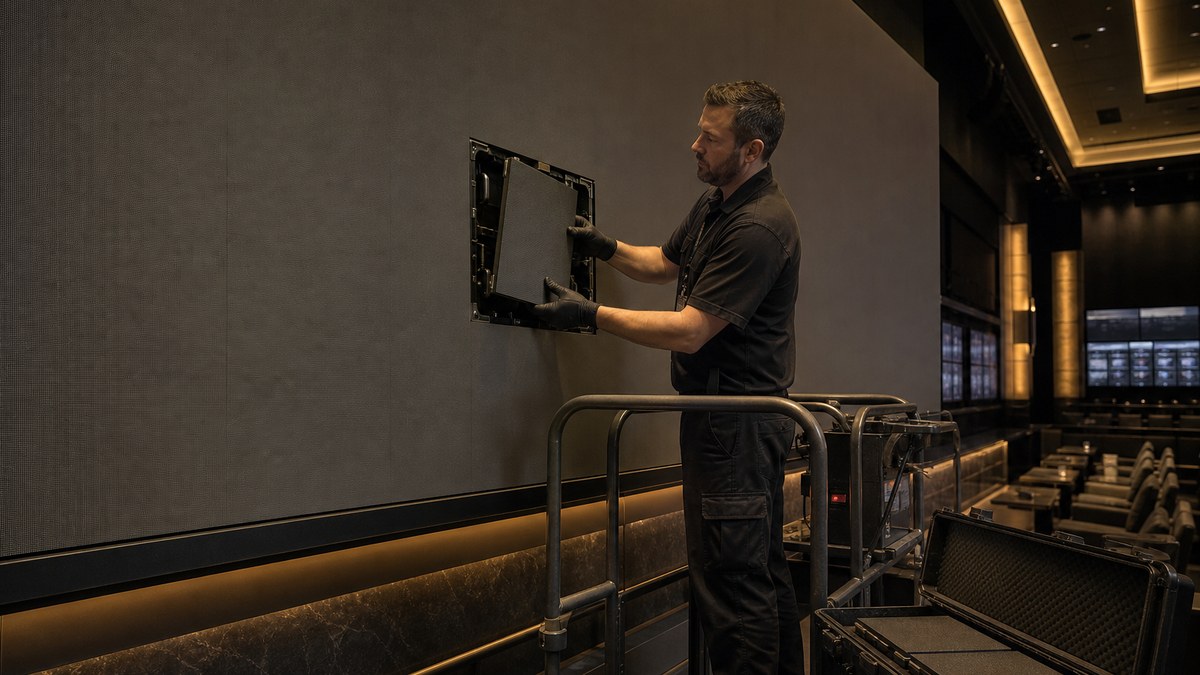
Step 5: structure, power, heat and service access
A wall of several thousand square feet is a building system, and it has to be designed into the building. Large LED walls are heavy, draw significant power at full white, and turn most of that power into heat inside an occupied room. These items belong in the architect's and engineers' drawings at design development, not in a change order.
| Item | What to decide | Who it involves |
|---|---|---|
| Structure | Wall or hung mounting, dead load, seismic bracing, deflection limits for a flat or curved face | Structural engineer, display manufacturer, GC |
| Power | Dedicated circuits, panel location, surge protection, emergency and standby strategy | Electrical engineer, licensed electrical contractor |
| Heat | Display heat load added to the HVAC calculation, airflow behind cabinets, fan noise | Mechanical engineer, display manufacturer |
| Service access | Front service (modules removed from the face) or rear service (a walkway behind the wall) | Architect, operator, manufacturer |
| Data and control | Equipment room, cable pathways, fiber runs, control system integration | AV integrator, IT, low-voltage contractor |
Front-serviceable walls save floor space and suit walls mounted flush to a structure. Rear-service designs need a walkway but let technicians work without touching the face during operating hours. On a 24/7 floor, either way, plan for how a technician gets to any module, power supply or receiving card with the room open.
Rule: every sportsbook wall needs attic stock. Keep spare modules, power supplies and receiving cards on site from the same production batch, so a failure on a Saturday is fixed overnight, not after a factory lead time.
Spare parts matter more as walls age. Older walls often hit the point where their modules are no longer made. If yours is there, our LED module and parts supply service sources matching or compatible modules, receiving cards and power supplies.
Step 6: phasing around the sports calendar
Every sportsbook has a calendar with no good week to close. Football season, the college basketball tournament and big fight weekends are the busiest stretches, and a renovation that runs into any of them costs the operator its best days. The Westgate SuperBook renovation, for example, was planned with demolition in mid-June, a first phase targeted before the end of August and completion by the end of September, so the book was ready for football.
- Order early: large LED walls are built to order. Manufacturing, shipping and staging lead times have to be in the schedule before demolition starts.
- Use the summer window: many books plan their heaviest work for the quieter period between the basketball finals and the start of football.
- Phase the room: keep part of the book, a temporary screen area or the counter running while the wall goes up.
- Pre-stage: assemble and test sections and processing off site where possible, so on-site time is spent mounting and commissioning.
- Commission before opening day: load the layouts, test every feed and run a full game-day rehearsal before the first big weekend.
Permits, licensing and who does what
An interior LED wall is electrical and structural work inside an occupied building, so it usually goes through building and electrical permits with Clark County or the relevant city. In Nevada, contracting work requires a license from the Nevada State Contractors Board in the right classification (for example C-2 for electrical work), and every bid must fall within the licensee's monetary limit. Exterior screens on a patio or pool deck, like the outdoor faces many books now add, may also raise sign-code questions; our LED marquee specification guide covers the exterior side.
On our projects, installation is performed by licensed, insured contracting partners, and every proposal names the licensed contractor performing the work. Our licensed installation partner has completed 200+ major sports and commercial projects across the US and Canada (NFL, NBA, NHL, MLS, NCAA, NASCAR venues), and we bring 15+ years as an authorized architectural lighting dealer and project coordinator. For design and documentation we work with architecture and engineering partners.
A sportsbook LED wall checklist for owners, architects and GCs
- Seating plan first: closest, typical and farthest viewing positions, including bars, suites and mezzanines.
- Pitch by surface: main wall, odds boards, close-up displays and any exterior screen each get their own pitch.
- Peak window count: how many games at once on the busiest day, at what minimum window size.
- Processing and control: number of sources, latency targets, layout presets, audio zones and redundancy.
- Brightness and glare: indoor brightness range, dimming, refresh rate for cameras and coordination with room lighting.
- Building systems: structure, dedicated power, HVAC heat load, data pathways and an equipment room.
- Service strategy: front or rear service, access during operating hours and attic stock from matched batches.
- Schedule: manufacturing lead time, off-season installation window, phasing and a full rehearsal before opening.
- Bid package: clear scope split between display supplier, AV integrator, electrical contractor and GC, with the licensed contractor named.
If the sportsbook is part of a new resort or a larger renovation, bring the display into design early alongside the rest of the lighting. Our guide to LED facade lighting and the design-assist timeline shows how that early coordination works on a new tower, and our look at the biggest LED projects in Las Vegas covers the exterior landmarks. Architects and contractors can see how we support design teams on our architects and GCs page, and owners planning exterior work should start with facade lighting and LED signs and marquees.
Frequently asked questions
What pixel pitch is best for a sportsbook LED video wall?
Choose pitch from the closest regular viewing distance. Using the common 10x rule, 2.5 mm suits viewers from about 25 feet, which is why several landmark Las Vegas books use 2.5 mm for their main walls. Close-up displays in suites and bars often use finer pitches, and high odds boards often use coarser ones such as 3.9 mm.
How big is the biggest sportsbook LED wall in Las Vegas?
Two books lead the public reporting. The Westgate SuperBook wall is about 20 feet tall and reported at 220 to 240 feet wide with more than 65 million pixels, and the Circa main wall is reported at about 118 by 38 feet with more than 66 million pixels across a three-story sportsbook.
How many games can a sportsbook video wall show at once?
It depends on the canvas resolution and processing. Circa's wall is reported to run up to 24 events at once, and Sunset Station's 152-foot wall can show up to 30 feeds. Size the wall for the number of games shown at the busiest moment of the season.
How do you calculate viewing distance for an LED wall?
The quick 10x rule multiplies pixel pitch in millimeters by 10 to get an approximate closest viewing distance in feet. The stricter visual acuity method multiplies pitch by 3,438 to get the distance in millimeters at which a person with 20/20 vision cannot see individual pixels, about 28 feet for 2.5 mm.
Should a sportsbook wall be front-serviceable or rear-serviceable?
Front service saves floor space and suits walls mounted flush to a structure, since modules are removed from the face. Rear service needs a walkway behind the wall but lets technicians work without touching the screen while the room is open. Decide early, because it changes the architecture.
How long does a sportsbook LED wall renovation take?
Schedules vary with scope, but the build has to fit the sports calendar. The Westgate SuperBook renovation, for example, ran from mid-June demolition to completion by the end of September, ahead of football. Manufacturing lead time for the LED has to be ordered before demolition starts.
Why are Las Vegas sportsbooks investing in bigger LED walls when most betting is mobile?
Because the book is now a viewing venue. Mobile accounted for 78.1% of Nevada sports betting handle in April 2025, so guests visit for the atmosphere, the seats and the screens rather than the counter. The LED wall is what draws them to the room.
What permits does an indoor LED video wall need in Las Vegas?
An indoor wall usually requires building and electrical permits with Clark County or the relevant city, and the work must be done by a contractor licensed by the Nevada State Contractors Board in the right classification, such as C-2 for electrical, within its monetary limit.
How much does a sportsbook LED video wall cost?
We do not publish prices. Cost depends on wall size and pixel pitch, processing and number of feeds, structure, power, HVAC, service access, control integration and schedule. Every project is bid to its own drawings and scope, and budget guidance is available during design-assist.
Related
Sources
- Daktronics, World's largest sportsbook informs and entertains bettors at Circa Resort & Casino (November 2020).
- AV Network, Analog Way Aquilons drive massive screens at Circa Resort and Casino.
- LSi Online, Westgate raises video wall bar with Christie Velvet (2016); ZeeVee, Westgate SuperBook LED video wall case study.
- Covers, Evolution of the sportsbook: how bettors are changing the face of Vegas books.
- Haute Living, An inside look at Las Vegas' new Durango Casino & Resort (December 2023).
- CDC Gaming, Sunset Station in Henderson unveils revamped sportsbook (May 2024).
- InGame, Nevada and Colorado April 2025 sports betting revenue.
- Planar, What is pixel pitch and why does it matter?
- Nevada Administrative Code 624.200 (classifications) and Nevada State Contractors Board licensing requirements.
Las Vegas LED Lights is independent and is not affiliated with the properties, operators, manufacturers or integrators named in this article, and did not work on these projects. Figures are as reported by the sources above at the time of publication. All images in this article are illustrations, not photographs of the sportsbooks described.