Home / Insights / Decorative LED site and street lighting in Las Vegas
Facades & New Construction · Site Lighting Guide
Decorative LED site and street lighting in Las Vegas, for resorts, mixed-use and master-planned projects
A planning guide for owners, developers, architects, landscape architects, lighting designers and general contractors: what Clark County's exterior lighting rules actually say, how to specify poles, bollards, festoon and landscape lighting that read as luxury rather than parking lot, and what a bid-ready decorative site lighting package should contain.
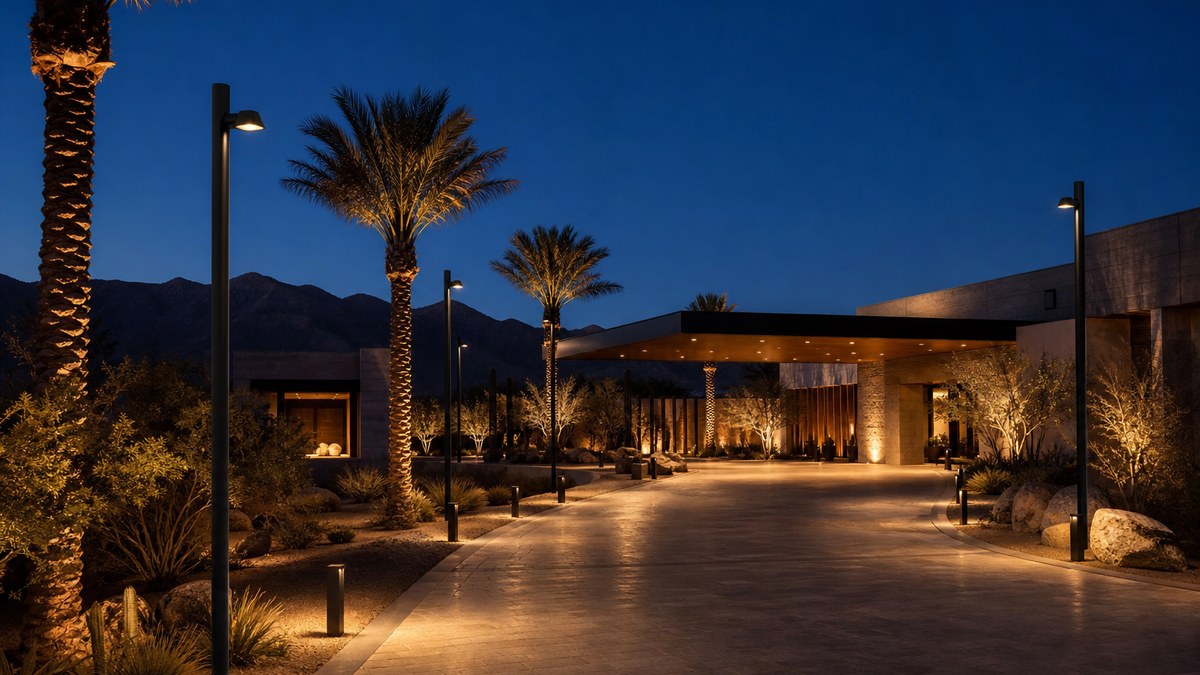
Decorative LED site lighting in Las Vegas covers every light outside the building that is chosen for how it looks as well as what it lights: pedestrian poles and post-tops along arrival drives and promenades, bollards and step lights, festoon and catenary strings over plazas, landscape and palm uplighting, entry monuments, parking-area poles, and the decorative street lights that frame a resort, mixed-use district or master-planned community. In unincorporated Clark County, which includes most of the Las Vegas Strip area, Paradise and Enterprise, that lighting has to meet Title 30 exterior lighting standards: shielded fixtures, no more than 0.2 footcandles at a shared property line, and in commercial districts warm light below 3,300 K and freestanding luminaires no taller than 25 feet, with important exemptions for the Las Vegas Boulevard Gaming Corridor and for street lights in the right-of-way.
Quick answer
Start by confirming the jurisdiction (unincorporated Clark County, City of Las Vegas, Henderson or North Las Vegas) and whether the site sits in the Las Vegas Boulevard Gaming Corridor or an overlay such as the Red Rock Overlay. Then design to the strictest rule that applies: fully shielded, downward-facing fixtures with a U0 uplight rating, warm white color temperature, pole heights inside the code limit, property-line photometric calculations, and automatic controls that dim or switch off after hours. Keep decorative effects static or slow near roadways, because Clark County prohibits flickering, pulsating and flashing lighting that could distract motorists or pilots. A bid-ready package adds a fixture schedule with BUG, CCT and ingress-protection ratings, stamped pole and foundation details, a controls narrative and a night-time aiming and commissioning plan.
We are a Las Vegas team that coordinates design-assist, product supply and licensed installation for large LED lighting, signage, facade and display projects, working with architecture and engineering partners and licensed, insured contracting partners. The public streetlight conversions mentioned in this article, by the City of Las Vegas and the City of Henderson, are referenced from public reporting only. We did not design, supply or install them, and we are not affiliated with those cities or the contractors that did the work.
What counts as decorative site and street lighting
On a large Las Vegas project, "site lighting" is often treated as a line item that the electrical engineer fills in late in design: a pole, a head, a photometric plan that meets minimum footcandles. Decorative site lighting is different. It is part of the architecture and the landscape design, and on a resort or high-end mixed-use project it is the first thing a guest sees at night. The arrival drive, the motor court, the pool deck edge, the retail promenade and the parking structure entrance all tell the guest what kind of property they have arrived at before they walk through the door.
The category usually includes:
- Pedestrian poles and post-tops along drives, walks and promenades, typically chosen to match the architectural language of the building.
- Bollards and step lights that define paths, steps and edges at low height without lighting the sky.
- Festoon and catenary lighting strung between poles or buildings over plazas, outdoor dining and event lawns.
- Landscape lighting: palm and tree uplighting, in-grade fixtures, wall grazing, water-feature lighting and accent lighting on planters and art.
- Entry and monument features: lit walls, gateway structures, site signs and sculptural elements at the property edge.
- Parking-area and drive lighting that has to deliver safe light levels while looking like part of the site rather than a highway.
- Decorative street lighting along public or private streets inside and around master-planned communities, campuses and districts.
Each of those elements sits under a different mix of rules. Some are on private property and fall under the site lighting section of the development code. Some sit in the public right-of-way and fall under public works standards. Some run at low voltage and are exempt from parts of the code. Getting the categories right at schematic design is what keeps a decorative concept from being value-engineered into generic poles at permit time.
| Element | Typical role | Key questions for the spec |
|---|---|---|
| Pedestrian poles and post-tops | Walkways, promenades, arrival drives | Pole height against the code limit, BUG rating, shielding, color temperature, finish and base detail |
| Bollards and step lights | Path edges, steps, low-height wayfinding | Glare at eye level, vandal resistance, ingress protection, heat on dark finishes |
| Festoon and catenary | Plazas, outdoor dining, event lawns | Shielded lamps or shades, structural attachment, wind, whether it reads as "flashing" if animated |
| Landscape and palm lighting | Accent, depth, night silhouette | Uplight aiming and spill above the canopy, low-voltage exemption, in-grade heat and drainage |
| Entry and monument features | Arrival, identity, property edge | Whether it is a sign (sign code) or architecture (site lighting), glare to drivers |
| Parking and drive poles | Safety, security, circulation | Footcandle targets, property-line trespass, pole height, after-hours dimming |
| Decorative street lights | Public or private streets in districts and communities | Right-of-way ownership, public works standards, utility coordination, maintenance responsibility |
Clark County's exterior lighting rules, in plain terms
Most of the resort corridor and a large share of the valley's new development sit in unincorporated Clark County, where the Unified Development Code (Title 30) governs site lighting. Section 30.04.07B, Exterior Lighting, states its purpose as enhancing safety, preserving the County's nighttime character and improving the ability to view the nighttime sky in outlying areas. The text below is summarized from the version of Title 30 posted by Clark County with an effective date of October 7, 2026; always confirm against the current version with your design team.
Exemptions that matter for big projects
Title 30 lists several kinds of lighting that are exempt from the exterior lighting section. For large hospitality and mixed-use work, these are the ones that change the design conversation:
- The Las Vegas Boulevard Gaming Corridor. Any development within the Las Vegas Boulevard Gaming Corridor, as defined in NRS 463.3076, is exempt. That is a large part of why the Strip can look the way it does. A project just outside the corridor, or a resort-adjacent residential or office component on a separate parcel, may not share the exemption, so confirm the boundary for each parcel early.
- Street lighting. Street light fixtures along rights-of-way are exempt from the site lighting section. They are governed instead by public works and subdivision requirements (more on that below).
- Landscape lighting of 50 volts or less. Low-voltage landscape lighting is exempt, which is one reason many palm and planter uplighting systems are designed as low-voltage runs.
- Life-safety lighting required by the Building Code, such as lighting for stairways, walkways and building entrances.
- Temporary uses such as special events with a temporary use approval, provided the lighting does not create glare to motorists or light trespass onto adjacent properties.
- Security lighting of any wattage controlled by a motion sensor that stays on no longer than 12 minutes after activation, plus FAA/FCC-required lighting and emergency lighting.
What is prohibited
Unless allowed elsewhere in Title 30, the County prohibits unshielded lighting that produces glare or light trespass beyond what the section allows; lighting affixed on top of or above a roof except where the Building Code requires it; interior or exterior flickering, pulsating, flashing, neon or any other lighting that could distract or confuse a motorist, pilot or air traffic controller; mercury vapor and low-pressure sodium lamps; and lighting that allows light to spill into the sky, visible on a roof or above the roof line.
Two of those deserve attention on decorative projects. First, the flicker-and-flash prohibition: color-changing festoon, chasing effects in bollards or animated landscape scenes can look fine on a rendering, but near a roadway they may be read as distracting. Static scenes, slow fades and effects confined to areas not visible from streets are the safer design approach, and the question should be put to the authority having jurisdiction before the controls are specified. Second, the sky-glow prohibition: palm uplighting and facade grazing that carry light past the top of the tree or the roof line are exactly what the rule targets outside the exempt areas.
The standards themselves
In all districts, Title 30 requires on-site lighting to be shielded or otherwise designed to prevent direct glare and light trespass onto adjacent property, sets a maximum of 0.2 footcandles measured at any shared property line, and encourages motion-sensitive lighting. In commercial, industrial and special districts it adds that all lighting shall be completely shielded and project downward; that warm light with a color temperature below 3,300 Kelvin is required, with white and blue-white prohibited; that the maximum height of a lamp on freestanding luminaires shall not exceed 25 feet (recreational field lighting excluded); that recreational field and outdoor sports or performance facilities, including swimming pools and arenas, use self-operating timers; that large recreation fields need only be partially shielded; and that all canopy lighting shall be recessed. If there is a complaint or enforcement action, County Code Enforcement may require a lighting plan that demonstrates compliance.
Rule: the 3,300 K limit and the full-shielding requirement are not a constraint on a luxury look. Warm white between 2,700 K and 3,000 K, fully shielded optics and low mounting heights are what high-end hospitality lighting looks like anyway. The projects that struggle are the ones that start with a generic cool-white parking-lot specification and try to dress it up later.
Overlays and other jurisdictions
The Red Rock Overlay
Projects inside Clark County's Red Rock Overlay (RRO) face tighter rules. For the overlay, Title 30 calls for accent lighting of plants, buildings and signage, and lighting for walkways and driveways, to be achieved with hidden lighting: surface-mounted lights, lamps recessed in soffits, overhangs and walls, lamps recessed in the ground and lamps hidden by plant materials. Floodlights and spotlights are not to be used unless approved as an integral architectural element. Exterior lighting is to be architecturally integrated and mounted no higher than the first-story eave or 14 feet above finished grade, whichever is lower. Illuminated roof canopies are prohibited, and exterior lighting must be completely shielded and oriented to focus light downward and inward from the property edge.
For parking, the overlay requires cut-off fixtures (no cobra heads) no taller than 35 feet, average site light levels limited to 2 footcandles with maximums of 16 footcandles measured 4 feet above the surface, an off-site maximum of half a footcandle beyond the property, and nonresidential outdoor lighting off during non-business hours except accent illumination. On the community side, street lighting is to be grouped with landscaping, street furniture, signs and utilities in clusters to reduce visual clutter. Seasonal holiday lighting and municipal safety lighting are excluded.
City of Las Vegas, Henderson and North Las Vegas
The incorporated cities each have their own development codes with their own lighting sections, overlay districts and review processes, and they update them on their own schedules. We do not summarize their numbers here because the right answer depends on the zoning district, overlay and current code version for each parcel. The practical step is the same everywhere: at kickoff, have the design team pull the current lighting section for the specific parcel, list every numeric limit (property-line footcandles, pole heights, color temperature, curfew hours) in the basis-of-design document, and design to that list. A master-planned project that crosses jurisdictional lines can end up with two sets of limits on one site, so the boundary should be drawn on the lighting plan.
For the code side of new-build packages, including Clark County's adoption of the 2024 IECC and its exclusions for casino theme elements, see our guide to LED lighting packages for new Las Vegas builds.
Streets in the right-of-way: a different rulebook
Decorative street lighting is where many master-planned and campus projects get surprised. Title 30 exempts street light fixtures along rights-of-way from the site lighting section, but that does not mean anything goes. For subdivisions, Title 30 requires the electrical distribution system to meet Clark County requirements and be sufficient to serve the development with streetlights and power to every lot, requires the developer to provide statements from the electric utility, requires street lighting materials, candlepower, illumination and installation to conform to recommended practice for street and highway lighting established by the Illuminating Engineering Society, and requires electrical improvements to meet the Clark County Electrical Ordinance.
In practice, that means a decorative street pole in a public right-of-way has to be acceptable to the public works department that will own or maintain it, not just to the architect. Questions to settle early:
- Who will own and maintain the street lights? Public streets, private streets maintained by an HOA or district, and resort-owned internal roads have different answers.
- Is the decorative pole on the jurisdiction's approved list, or does it need an approval process? Custom poles can be possible, but they bring spare-parts and maintenance obligations.
- Do the photometrics meet IES roadway and walkway practice while still matching the color temperature and look of the private site lighting next to them?
- How does the street lighting transition at the property line? A warm 2,700 K resort drive meeting a cooler public street can look like a mistake if nobody coordinated the two.
What the big public conversions show
Southern Nevada's cities have already moved their public streetlights to LED at scale, which sets the baseline that private decorative lighting sits next to. The Las Vegas Sun reported in February 2014 that the City of Las Vegas had switched its roughly 40,000 streetlights from high-pressure sodium to LED starting in 2010, and that a Public Works study measuring 600 streetlights in 21 parts of the city found average light output well above Illuminating Engineering Society standards in every case. In Henderson, KLAS-TV reported in 2024 that the city was preparing to upgrade about 31,000 public streetlights to LED; the total of 30,829 fixtures included 17,041 on residential roadways, 8,439 on major and arterial roads and 5,349 collector fixtures, with the city projecting a 35% reduction in electricity consumption and a lifespan of 15 years or more.
The lesson for private developers is not about those programs themselves. It is that public streetlights are standardized, utility-scale systems designed for roadway performance, and private decorative lighting is judged against them every night. Coordinating color temperature, mounting height and glare at the edges of the site is what makes a project look intentional.
BUG ratings: turning "shielded" into a specification
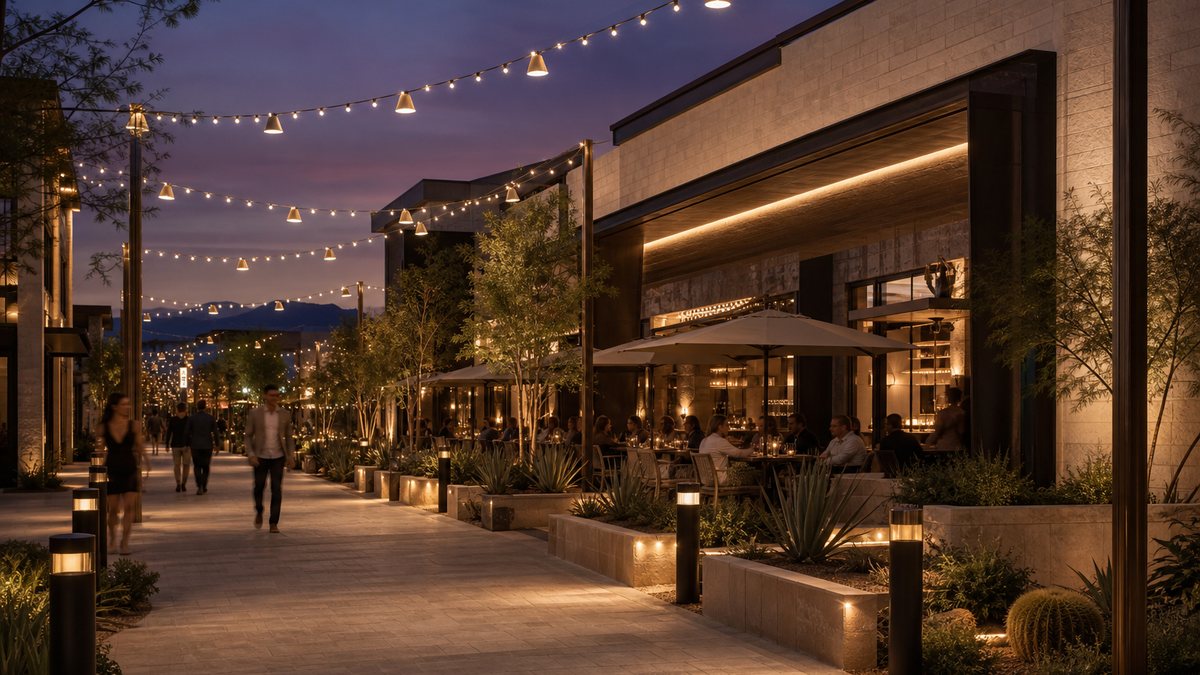
Codes say "shielded" and "completely shielded"; manufacturers publish BUG ratings. Connecting the two is the most useful thing a site lighting specification can do. BUG stands for Backlight, Uplight and Glare. According to the Texas Department of Transportation's Highway Illumination Manual, the Illuminating Engineering Society used the cutoff classification system to rate uplight before 2007, when cutoff classifications were replaced with BUG ratings, now specified in IES TM-15-11. Each component is rated on a scale from 0 to 5; the uplight rating ranges from U0, with no uplight, to U5.
- Backlight (B) is light directed behind the fixture. It is the component that most often causes light trespass across a property line when poles sit near the edge of a site.
- Uplight (U) is light above the horizontal plane of the luminaire. A U0 fixture emits no light into the night sky when mounted level, which is the clearest way to document "completely shielded" and "no spillage into the sky."
- Glare (G) is light emitted at high angles. It drives visual comfort for guests and drivers, and it is often the difference between a fixture that looks elegant and one that looks harsh.
For decorative poles and post-tops, the practical spec language is: U0 where the code requires complete shielding, a maximum backlight rating for fixtures within a set distance of a property line, a maximum glare rating for pedestrian areas, mounting level with no tilt, and a requirement that the submitted photometric files match the exact optic, lumen package and color temperature specified. Decorative "lantern" styles with exposed lamps can fail these tests even when they look traditional, so ask for the BUG rating of the actual configuration, not the product family.
Designing a luxury look inside the rules
The best decorative site lighting in a market like Las Vegas is restrained. It relies on a few principles that also make code compliance easier:
- One warm color temperature across the site. Pick 2,700 K or 3,000 K and hold every element to it: poles, bollards, festoon, landscape and facade accents. Mixed color temperatures are the fastest way to make an expensive site look cheap.
- Light surfaces, not the sky. Grazing a wall, washing a canopy underside or lighting a path from a bollard reads as luxury; floodlighting a facade from a pole reads as security lighting.
- Lower and more fixtures, rather than fewer tall ones. Pedestrian-scale poles and bollards at lower heights give better uniformity and less glare than a few tall poles, and they stay well inside height limits.
- Hide the source. Recessed step lights, concealed linear LED in benches and planters, and shielded festoon shades keep the light and lose the glare.
- Layer by time of night. Arrival-hour scenes, late-evening scenes and after-hours security levels should be programmed, not left on one switch.
Where the site lighting meets the building, coordinate with the facade lighting design so the two read as one composition. Our guides to LED facade lighting for new Las Vegas resorts and choosing a facade lighting company cover the building side of that coordination, and our facade lighting and new construction page outlines how we support it.
Built for the desert: heat, dust, wind and sun
Outdoor fixtures in Southern Nevada work harder than the same fixtures in most of the country. Las Vegas reached an all-time high of 120°F at Harry Reid International Airport on July 7, 2024, and that is air temperature; dark poles, in-grade fixtures and bollards sitting on hardscape run hotter. Specification points that hold up in this climate:
- Ingress protection. Under IEC 60529, a first digit of 6 means dust-tight, and second digits of 6 and 7 cover powerful water jets and temporary immersion. In-grade and landscape fixtures near irrigation should be rated for the water they will actually see.
- Thermal rating of the driver and LED. Ask for the fixture's rated ambient temperature and how lumen maintenance was projected. LM-80 testing runs at least 6,000 hours, and TM-21 is the method used to project lumen maintenance from that data.
- Finishes and materials. UV-stable powder coat, hardware that resists corrosion where irrigation water hits it, and lenses that will not yellow in years of desert sun.
- Poles and foundations. Pole, base and anchor-bolt design for wind loads under the adopted building code, by a licensed engineer, with stamped details on the drawings. Festoon and catenary systems need engineered attachment points and tensioning that account for wind.
- Serviceability. Tool-accessible drivers, standard replacement parts and a spare-parts list in the contract. A custom decorative pole that cannot be repaired quickly becomes a dark spot on the arrival drive.
For more on ingress ratings, DMX and lumen maintenance testing, see our guide to what a facade lighting bid should prove.
Controls: schedules, dimming and the after-hours scene
Controls are where decorative site lighting earns its keep. A well-designed system lets the property run a full arrival scene in the evening, step down late at night, and drop to security levels after closing, all automatically. It also makes compliance easier: Title 30 encourages motion-sensitive lighting and exempts motion-controlled security lighting that stays on no more than 12 minutes after activation, Red Rock Overlay sites must turn nonresidential lighting off during non-business hours except accent illumination, and the adopted energy code requires automatic controls on exterior lighting.
A controls narrative for a large site should cover:
- Astronomical time scheduling (dusk-to-dawn without photocell drift) with scenes for arrival, late evening and after-hours.
- Dimming of decorative and landscape zones after business hours, with security and life-safety zones kept separate.
- Occupancy or motion sensing in parking areas and back-of-house walks where it suits the operation.
- Event scenes for plazas and lawns, with any dynamic effects confined to areas not visible from public roads and approved in advance where needed.
- Integration with the facade or show-control system when site and building lighting are meant to work together.
- Remote monitoring of failures, so a dark pole is caught by the system rather than by a guest.
Planning decorative site, streetscape or campus lighting for a Las Vegas resort, mixed-use or master-planned project?
Send the site plan, landscape plan, an RFP or a short description of the project. We will help confirm the jurisdiction and overlays, coordinate photometrics and fixture selection with your design team, and prepare a bid-ready proposal with the licensed contractor named.
What a bid-ready decorative site lighting package includes
Decorative site lighting is often bid as part of the electrical package, which means the decorative intent can get lost in a substitution. A package that protects the design and lets contractors price it cleanly includes:
| Deliverable | Who usually prepares it | Why it matters |
|---|---|---|
| Basis of design with jurisdiction, overlays and every numeric lighting limit | Lighting designer with the architect | Everyone designs and bids to the same rules |
| Photometric plan with property-line calculations | Lighting designer or electrical engineer | Shows trespass limits (for example 0.2 fc in Clark County) are met before permit |
| Fixture schedule with BUG rating, CCT, lumen package, IP rating, finish and mounting height | Lighting designer | Makes "or equal" substitutions measurable rather than subjective |
| Pole, base and foundation details | Licensed structural engineer | Wind and soil design stamped for permit; avoids field redesign |
| Festoon and catenary attachment and tension details | Licensed engineer with the lighting designer | Prevents sagging, failures and unapproved attachments to the building |
| Controls narrative and zoning diagram | Lighting designer or controls specialist | Defines scenes, schedules, dimming and code-required automatic controls |
| Right-of-way coordination notes | Civil engineer with public works | Clarifies which poles are public, which are private and who maintains them |
| Mockup, aiming and night commissioning plan | Lighting designer with the installing contractor | Confirms the look and the photometrics on site, at night, before turnover |
| Spares and maintenance list | Supplier with the owner's facilities team | Keeps decorative fixtures matched and serviceable for years |
How the package is bid depends on the delivery model. Under design-assist, the lighting supplier and installer join early and help refine the package; under plan-and-spec, the package must be complete enough to bid as drawn; under design-build, one team carries both design and installation responsibility. Our comparison of design-build, design-assist and plan-and-spec for LED work explains the trade-offs.
From schematic design to the first night
A typical sequence for decorative site lighting on a large Las Vegas project looks like this:
- Schematic design. Confirm jurisdiction, overlays and corridor boundaries for every parcel; set the color temperature and the visual concept; identify which elements are private site lighting, which are right-of-way street lighting and which are signs.
- Design development. Select fixture families, run preliminary photometrics including property-line calculations, check pole heights and BUG ratings against the limits, and coordinate with landscape, civil and facade lighting.
- Construction documents. Finalize the fixture schedule, stamped pole and foundation details, controls narrative, circuiting and the right-of-way submittals.
- Permitting and approvals. Submit to the authority having jurisdiction, and to public works for any street lighting in the right-of-way.
- Submittals and mockup. Review photometric files and samples against the specification, then build a night mockup of the key elements (a pole, a bollard run, a festoon span, a palm) before ordering in quantity.
- Installation. Foundations and conduit early with civil work; poles and fixtures late enough to avoid damage from other trades.
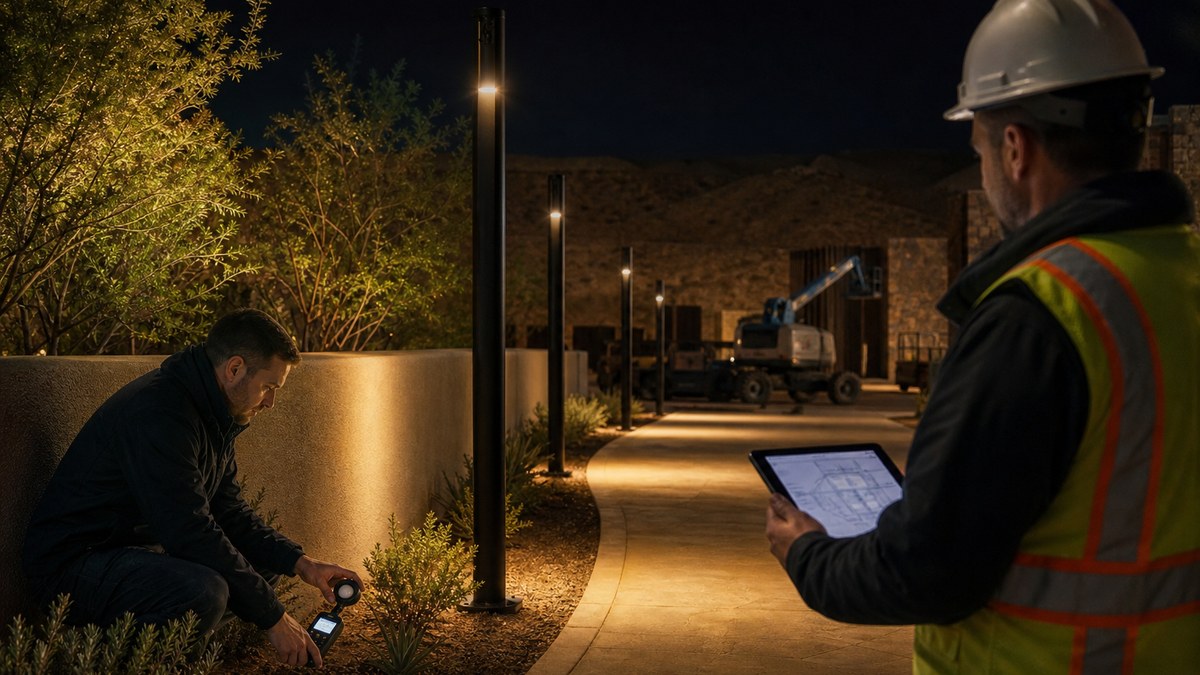
- Aiming and commissioning. Aim and program at night, verify property-line levels with a meter, set schedules and scenes, and train the facilities team.
On new resort and mixed-use projects, the site lighting package often travels with the larger building lighting scope. Our guide to LED lighting packages for new construction shows how those scopes fit together, and our hotel and casino LED lighting page covers the porte-cochere, pool and tower lighting that decorative site lighting usually connects to.
Licensing and who does the work
In Nevada, contractors must hold a license from the Nevada State Contractors Board (NSCB) in the right classification. Electrical work falls under C-2 and signs under C-6, and a contractor's bid must be within its license's monetary limit. The NSCB's tips for owners include checking that a license is valid and active, that the contractor is working within its classification, and that it is bidding within its monetary limit; licenses can be checked with the NSCB's public license search. Site lighting that includes illuminated monument signs or wayfinding can involve both the electrical and the sign side, so ask how the proposal covers each.
On our projects, installation is carried out by licensed, insured contracting partners, and every proposal names the licensed contractor. Our licensed installation partner has completed 200+ major sports and commercial projects across the US and Canada (NFL, NBA, NHL, MLS, NCAA, NASCAR venues), and our team brings 15+ years as an authorized architectural lighting dealer and project coordinator. Design support comes through our architecture and engineering partners. If your project also includes signage or displays, see our LED signs and marquees and LED video walls and modules pages, including replacement LED modules and parts.
Common mistakes on decorative site lighting
- Assuming the Strip's rules apply next door. The Las Vegas Boulevard Gaming Corridor exemption does not follow a project onto parcels outside the corridor.
- Specifying a product family instead of a configuration. BUG ratings, lumen output and color temperature change with the optic and options; specify the exact configuration.
- Leaving property-line calculations to the end. Poles near a lot line can fail a 0.2 fc limit on backlight alone; fix it with optics or layout before the poles are ordered.
- Animating everything. Color-changing and chasing effects near roads can conflict with the prohibition on flashing and pulsating lighting.
- Uplighting past the canopy. Palm and tree uplights that spill above the canopy add sky glow outside exempt areas and waste light.
- Ignoring maintenance. Custom decorative fixtures need spares and a service plan; otherwise the first failure becomes a permanent dark spot.
- Not coordinating with the street. A site that does not match the color temperature or scale of adjacent public lighting looks unfinished at night.
Frequently asked questions
What are the outdoor lighting rules for commercial projects in unincorporated Clark County?
Title 30 section 30.04.07B requires on-site lighting to be shielded to prevent glare and light trespass, with no more than 0.2 footcandles at any shared property line. In commercial, industrial and special districts, lighting must be completely shielded and project downward, color temperature must be below 3,300 K, freestanding luminaires are limited to a 25-foot lamp height (recreational field lighting excluded) and canopy lighting must be recessed. Confirm the current version with your design team.
Is the Las Vegas Strip exempt from Clark County's exterior lighting standards?
Title 30 exempts any development within the Las Vegas Boulevard Gaming Corridor, as defined in NRS 463.3076, from the exterior lighting section. Parcels outside the corridor, including some resort-adjacent residential, office or retail parcels, may not share the exemption, so the boundary should be confirmed for each parcel at the start of design.
Are decorative street lights covered by the same rules as site lighting?
No. Title 30 exempts street light fixtures along rights-of-way from the site lighting section. Street lighting is instead governed by public works and subdivision requirements; for subdivisions, Title 30 calls for street lighting to conform to Illuminating Engineering Society recommended practice for street and highway lighting and for electrical work to meet the Clark County Electrical Ordinance. Decorative poles in a right-of-way need the approval of the agency that will own or maintain them.
What color temperature should decorative LED site lighting be in Las Vegas?
In unincorporated Clark County's commercial, industrial and special districts, warm light below 3,300 K is required and white and blue-white light is prohibited. For high-end hospitality and mixed-use projects, 2,700 K or 3,000 K held consistently across poles, bollards, festoon, landscape and facade accents gives the best result.
What is a BUG rating and what should we specify?
BUG stands for Backlight, Uplight and Glare, defined in IES TM-15-11, with each component rated from 0 to 5. BUG ratings replaced the older cutoff classifications in 2007. Where a code requires complete shielding, specify U0 (no uplight) with level mounting, limit backlight for fixtures near property lines, limit glare in pedestrian areas, and require photometric files for the exact configuration.
Can we use color-changing or animated festoon and landscape lighting?
Use caution. Clark County prohibits interior or exterior flickering, pulsating, flashing or neon lighting that could distract or confuse a motorist, pilot or air traffic controller, outside exempt areas. Static scenes and slow fades are the safer approach, dynamic effects should be confined to areas not visible from public roads, and the authority having jurisdiction should be consulted before such effects are specified.
How tall can site light poles be?
In unincorporated Clark County's commercial, industrial and special districts, the lamp on a freestanding luminaire may not be higher than 25 feet, with recreational field lighting excluded. In the Red Rock Overlay, parking-area fixtures are limited to 35 feet and other exterior lighting to the first-story eave or 14 feet, whichever is lower. The cities set their own limits, so check the current code for each parcel.
Is low-voltage landscape lighting exempt?
Title 30 exempts landscape lighting of 50 volts or less from the exterior lighting section. That exemption does not remove the practical reasons to aim carefully: uplighting that spills above trees and roof lines still adds glare and sky glow, and overlay rules or project design standards may be stricter.
What should a bid for decorative site lighting include?
A bid-ready package should include a basis of design listing every applicable numeric limit, a photometric plan with property-line calculations, a fixture schedule with BUG, color temperature, lumen package, IP rating and finish, stamped pole and foundation details, festoon attachment details where used, a controls narrative, right-of-way coordination notes, a mockup and night commissioning plan, and a spares list. The proposal should name the licensed contractor who will install it.
Do you only work on large projects?
Our focus is large Las Vegas work: resorts, casinos, hotels, mixed-use and master-planned developments, commercial campuses and new construction, where decorative site lighting is part of a broader lighting, signage or facade scope. We coordinate design-assist and supply with architecture and engineering partners, and installation through licensed, insured contracting partners.
Related
Sources
- Clark County, Title 30 Unified Development Code (version effective October 7, 2026): §30.04.07B Exterior Lighting; §30.02.26H Red Rock Overlay; street lighting and electric service requirements for subdivisions.
- Texas Department of Transportation, Highway Illumination Manual: Cutoff and BUG Rating.
- Landscape Forms, BUG Rating System 101.
- Las Vegas Sun, Study finds Las Vegas streetlights plenty bright (February 5, 2014).
- KLAS-TV (via AOL), Henderson to upgrade 31K streetlights to energy-saving LED lights (2024).
- Nevada State Contractors Board, Tips for Nevada contractors.
- Our earlier guides for code and testing background: Clark County 2024 IECC and IP ratings, LM-80/TM-21 and the 2024 Las Vegas heat record.
Las Vegas LED Lights is independent and is not affiliated with the cities, agencies, organizations or manufacturers named in this article, and did not design, supply or install the public streetlight programs referenced. Code, licensing and permit information is a summary for planning purposes, not legal advice; confirm requirements with the Nevada State Contractors Board, the authority having jurisdiction and your design team. All images in this article are illustrations, not photographs of real projects.