Home / Insights / Choosing a facade lighting company
Facades & New Construction · Contractor Selection
How to choose a facade lighting company in Las Vegas, and what an RGB facade bid should prove
A selection guide for owners, architects, lighting designers and general contractors: the licensing to check in Nevada, how to compare RGB, RGBW and tunable-white facade systems, what controls and data planning should look like, why mock-ups decide the result, and the service questions that matter ten years after opening.
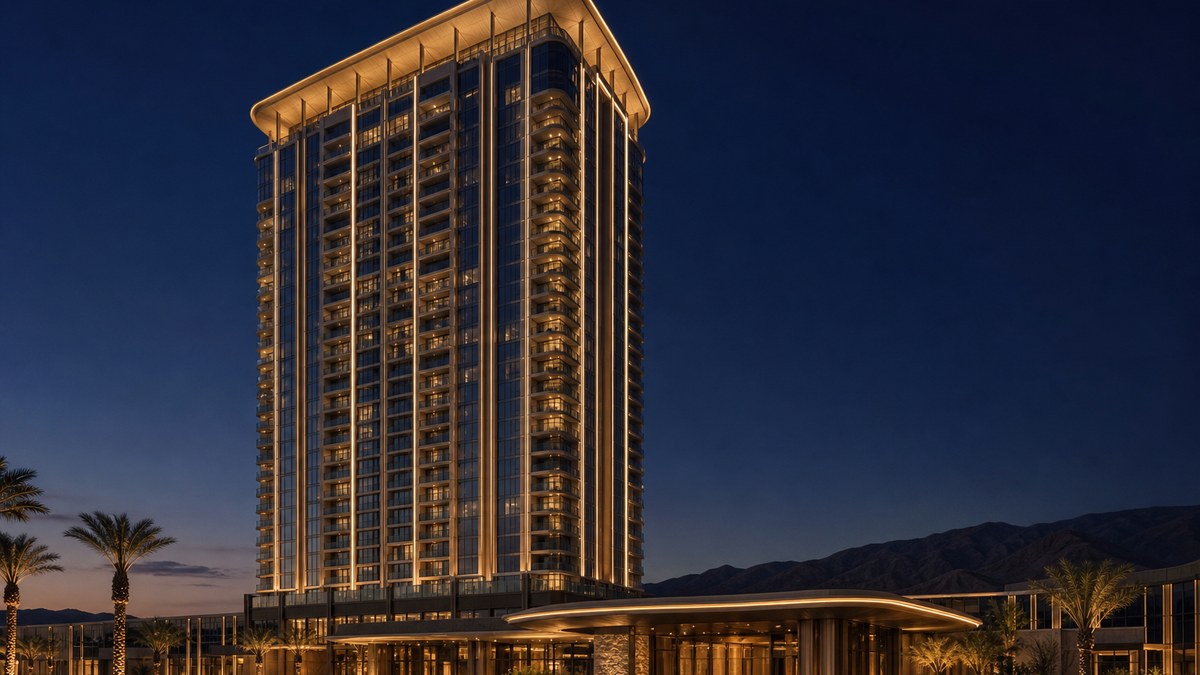
Choosing a facade lighting company in Las Vegas comes down to five things: the right Nevada contractor license for the work and the bid amount, real experience with exterior LED systems at building scale, a controls and data plan that matches the design intent, a mock-up process that proves the look before you buy it, and a service plan for parts, programming and access after opening. On a resort, casino, hotel or commercial tower, the facade is the most visible lighting on the project and one of the hardest to fix later, so the selection matters as much as the fixture schedule.
Quick answer
To choose a facade lighting contractor in Las Vegas, confirm an active Nevada State Contractors Board license in the right classification with a monetary limit that covers the bid, ask for exterior LED projects of similar scale, and require a written controls and data plan (protocol, universes, network, show control). Ask for a site mock-up, named products with heat and water ratings suited to the desert, a commissioning plan and a parts and service plan. Compare bids line by line on scope, not on a single number. We do not publish prices: every facade is bid to its own drawings and design intent.
We are a Las Vegas team that coordinates design-assist, product supply and licensed installation for large LED lighting, signage, facade and display projects. The Strip projects mentioned in this article, such as the Resorts World west tower display and the Fontainebleau marquee, are referenced from public reporting only. We did not design, supply or build them, and we are not affiliated with those properties.
What a "facade lighting company" actually does on a big job
Search for a facade lighting company and you will find everyone from sign shops to electrical contractors to manufacturers' reps. On a Las Vegas resort or commercial tower, facade lighting is a system, and no single trade covers all of it by default. A complete facade scope usually includes:
- Design support: working with the architect and lighting designer on the effect, fixture types, optics, color, spacing and the mounting details on the curtain wall, fins, crown or podium.
- Product: linear grazers and wash lights, pixel or dot luminaires for building outline and media effects, floodlights for the crown, and the power supplies and data equipment that drive them.
- Controls: the lighting controller or media server, the data network, show programming, schedules and integration with the building management system.
- Installation: licensed electrical work, structural attachments approved by the engineer of record, and access planning for work at height.
- Commissioning and service: addressing, testing, focusing, programming and handover, then spare parts, firmware, content changes and repairs for years.
The right company either covers all of these or coordinates partners who do, with clear interfaces between them. The wrong one sells fixtures and leaves the controls, data, structure and access for someone else to discover in construction.
Check 1: Nevada licensing and the monetary limit
In Nevada, contracting work requires a license from the Nevada State Contractors Board (NSCB). Facade lighting is electrical work, so the installing contractor generally needs the electrical classification (C-2); illuminated signs fall under the sign classification (C-6), as set out in Nevada Administrative Code 624.200 and 624.240. Where a facade includes a marquee, a display or illuminated signage, check that the classifications on the license cover every part of the scope.
The NSCB's own guidance for owners is short and practical: check that the license is valid and active, that the work is within the contractor's license classification, and that the amount of the bid or contract is within the contractor's monetary limit. The board provides a public license search for this. On a large facade package, the monetary limit is the item most often overlooked: a capable contractor with a limit below the contract value is not eligible to sign that contract.
- Look up the license number on the NSCB license search and confirm it is active.
- Confirm the classification matches the work: electrical for the facade lighting, sign for illuminated signage.
- Confirm the monetary limit covers the contract value, including alternates you may accept.
- Ask who is the licensed contractor of record, and get it in writing in the proposal.
Our approach is simple: installation is performed by licensed, insured contracting partners, and every proposal names the licensed contractor performing the work. Our licensed installation partner has completed 200+ major sports and commercial projects across the US and Canada (NFL, NBA, NHL, MLS, NCAA, NASCAR venues).
Rule: if a facade proposal does not name the licensed installing contractor, its classification and its license number, it is not ready to compare.
Check 2: Experience with exterior LED at building scale
A lobby cove and a 40-story curtain wall are different problems. Exterior facade work adds heat, sun, wind, water, dust, structure, access and data distances that interior lighting never sees. When you review experience, ask for projects that share the hard parts of yours, not just the same building type.
Questions that separate real facade experience
- What is the largest exterior pixel or linear system you have commissioned, and how was it controlled?
- How did you handle attachment to the curtain wall or fins without penetrating the waterproofing, and who signed off on the detail?
- How were power supplies and data equipment located for heat and service access?
- What failed in the first year, and how was it fixed?
- Who on your team will program the shows, and who will we call after handover?
The answers tell you more than a portfolio. A team that can describe its failures, its fixes and its access plans has actually lived through a facade project. If the project also includes signage or a marquee, see our guide on how to specify an LED marquee sign in Las Vegas, because sign and facade work often share structure, power and controls.
Check 3: RGB, RGBW or tunable white, matched to the design intent
Many searches for this topic ask about RGB commercial facade lighting. Color-changing capability is useful, but the color system should follow the design, not the other way around. The main options:
| System | What it does well | Watch for |
|---|---|---|
| Static white | Refined architectural grazing and washing in a fixed color temperature, simplest to control and maintain | No flexibility for events, holidays or brand moments |
| Tunable white | Warm to cool white shifts through the evening; elegant, restrained looks suited to luxury hospitality | Color consistency between batches and over time; control channels double |
| RGB | Saturated color and dynamic effects for shows and celebrations | Mixed whites from RGB can look cold or uneven; poor fit if most of the night is meant to be white |
| RGBW / RGBA | Saturated color plus a dedicated white or amber channel for clean, warm whites and pastels | More channels per pixel, so more data universes and more programming |
| Pixel / media facade | Individually addressed points or lines that can play video-like content across the building | Content, data network, mapping and maintenance become a project of their own |
For most high-end Las Vegas resorts, the strongest facades spend most of the night in warm or tunable white and save saturated color for specific moments. That is why RGBW, or a combination of tunable-white grazing with a pixel layer for outline and events, is often a better answer than a pure RGB system. A good facade lighting company will ask how the owner wants the building to read on an ordinary Tuesday before it talks about color effects.
Color quality is also a durability question. Ask how the manufacturer bins LEDs, how color consistency is controlled between production runs, and how replacement fixtures years later will match the ones already installed. On long runs of linear grazers, a small color shift between batches is visible from across the street.
Check 4: Controls, data and the DMX math
Facade lighting is controlled over a data network, and the network design is where many projects quietly go wrong. Exterior systems typically use DMX512, often carried over Ethernet as sACN or Art-Net, with RDM for remote device management where the fixtures support it. The math matters early: a DMX universe has 512 channels, so it holds 170 RGB pixels (3 channels each) or 128 RGBW pixels (4 channels each). A pixel never spans two universes, so spare channels at the end of each universe are normal.
That arithmetic drives real equipment. A building outline with thousands of RGBW pixels needs many universes, which means more data nodes, more network ports, more cable routes and more places to locate equipment where it stays cool and reachable. When a bid is vague about controls, ask for:
- A riser or block diagram showing controllers, data nodes, network switches, power supplies and fixture runs.
- The control protocol and the universe count, with spare capacity.
- Where the controller and data equipment live, and how they are cooled and secured.
- How the system connects to the building management system, astronomical time clocks and any show or event triggers.
- Who owns the programming files, show content and passwords at handover.
Rule: the controls plan is part of the facade, not an afterthought. If it is not drawn before bid, it will be invented during construction.
Comparing facade lighting proposals for a Las Vegas project?
Send the drawings, specifications or plan-room link. We review the facade scope, controls and interfaces, flag gaps between trades, and prepare a proposal that names the products and the licensed installing contractor. Design teams can bring us in earlier for design-assist, mock-ups and budget guidance.
Check 5: Products built for the Mojave, not just rated for outdoors
Las Vegas is a hard place for electronics on a building exterior. The valley reached 120°F at Harry Reid International Airport on July 7, 2024, its hottest day on record, according to the National Weather Service as reported at the time. A dark facade in direct sun can run far hotter than the air temperature, and power supplies tucked into closed spaces run hotter still. Add ultraviolet exposure, wind-driven dust, monsoon storms and window-washing equipment, and outdoor-rated is a starting point, not an answer.
Specifications worth asking about
- Ingress protection: under IEC 60529, the first digit 6 means dust-tight; a second digit of 6 means protected against powerful water jets, and 7 means protected against temporary immersion. Facade fixtures that see window-washing rigs and storms should be rated for it, and so should their connectors.
- Operating temperature: ask for the rated ambient range of fixtures and power supplies, and how the design accounts for solar gain on the facade.
- Lumen maintenance: IES LM-80 measures how LED packages lose light over at least 6,000 hours of testing, and IES TM-21 is the recommended method for projecting that loss further. Ask for the data at temperatures close to how the fixture will actually run.
- Materials and finish: UV-stable lenses, marine-grade or powder-coated housings, and stainless hardware that will not stain the cladding.
- Surge and power quality: long exterior runs and rooftop equipment benefit from surge protection and a clear power distribution design.
These details belong in the specification and the submittals. A facade lighting company that leads with them, rather than with renderings, is usually the one you want on the job. For the broader scope of what a new-build package includes, see LED lighting packages for new Las Vegas builds.
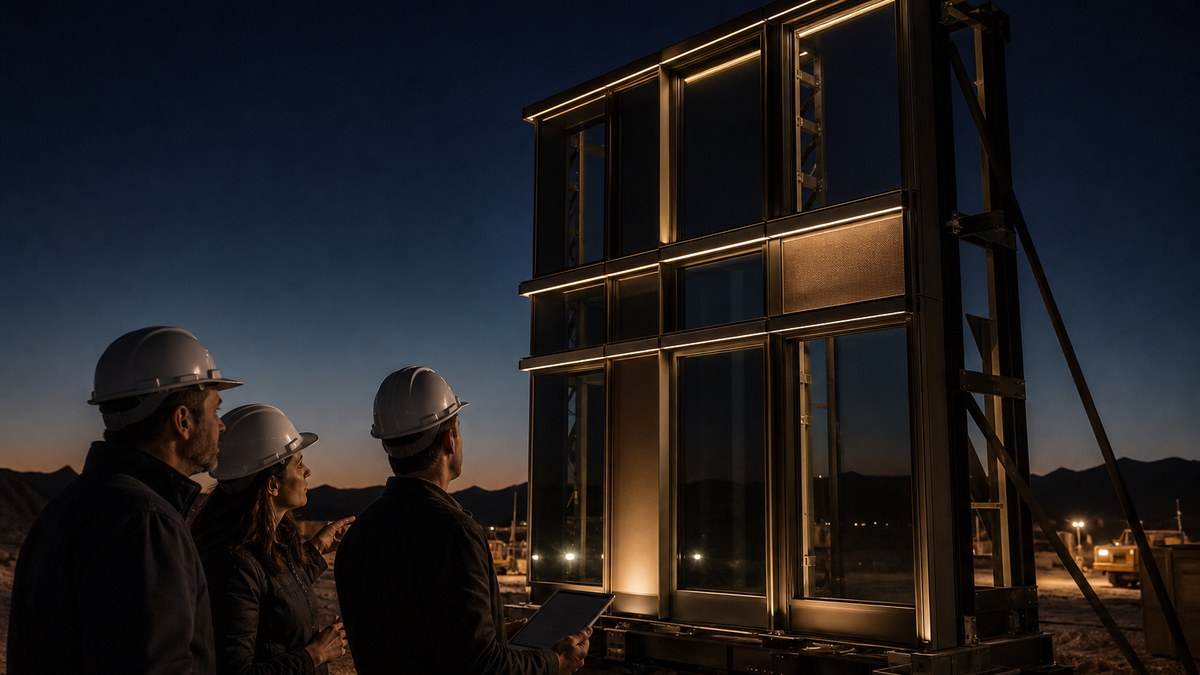
Check 6: Mock-ups and the design-assist timeline
The most reliable way to judge a facade lighting company is to watch how it runs a mock-up. A good mock-up puts sample fixtures on the actual cladding or a full-size section of it, viewed at night from the distances that matter: the Strip, the approach road, the porte-cochere and the guest rooms of neighboring towers. It answers questions about brightness, spacing, beam spread, color temperature, glare and how the fixtures look in daylight when they are off.
Mock-ups have to happen early enough to change the design. That is why facade lighting works best with design-assist: the lighting team joins during schematic design or design development, supports the architect and lighting designer with options and constructability input, and helps the facade, structural and electrical drawings carry the right details before bid. We cover the stages in detail in LED facade lighting for new Las Vegas resorts and towers, the design-assist timeline.
When comparing companies, ask:
- When in the schedule would you run the mock-up, and what would it test?
- Who attends: owner, architect, lighting designer, curtain wall contractor, electrical contractor?
- How are mock-up decisions recorded and carried into submittals?
- Can the mock-up fixtures and controls be the same models proposed in the bid?
Check 7: Coordination with the curtain wall, structure and access
On a tower, the facade lighting is attached to someone else's work. The curtain wall contractor owns the cladding and its warranty, the structural engineer owns the attachment design, and the general contractor owns the schedule and the access equipment. A facade lighting company that cannot coordinate with all three will create change orders.
- Attachment details: who designs the brackets, who approves them, and how they avoid penetrating waterproofing or voiding the cladding warranty.
- Cable routing: where power and data run behind or through the facade, and how they are protected from heat and UV.
- Sequencing: whether fixtures and wiring go in at the curtain wall plant, during erection, or after, and what that means for the schedule.
- Access for service: building maintenance units, window-washing rigs, boom lifts or rope access, and whether fixtures and power supplies can be reached without them.
The access question deserves extra attention. A fixture that takes a building maintenance unit and a closed lane to replace is far more expensive to keep running than one that can be serviced from a parapet or an interior soffit. Good facade designs plan for the repair as carefully as for the installation.
Check 8: Commissioning, handover and service
Facade lighting is not finished when it turns on. Commissioning includes addressing every fixture, verifying data and power, focusing and aiming, programming shows and schedules, testing failure modes and training the owner's team. Handover should include as-built drawings, the fixture address map, programming files, spare parts and a clear list of who to call.
After opening, the questions shift to service. Ask each company:
- What attic stock of fixtures, power supplies and data equipment is included, and how will it match the installed batch?
- How long will the manufacturer support the product line, and what happens if it is discontinued?
- Who updates programming for events and holidays, and how quickly?
- What is the response plan when a section of the facade goes dark?
For existing properties, many of the calls we get start here: a dark run of linear fixtures, a failed power supply, or pixel modules that are no longer made. Our LED modules and parts supply covers matching or compatible modules, power supplies and data equipment for systems already in service.
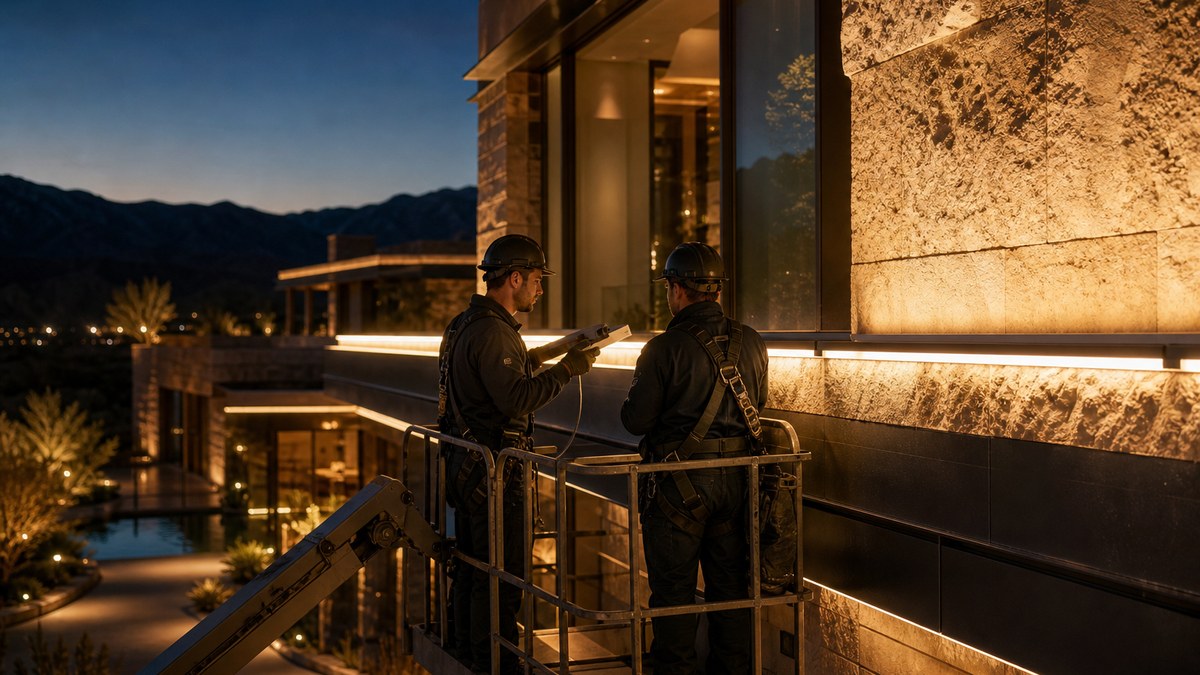
What the Strip shows about facade scale
A few public examples show how far exterior LED has gone in Las Vegas, and why the selection of the right team matters. Resorts World Las Vegas previewed a 100,000-square-foot direct-view LED screen on its west tower in July 2020, built from more than 3,500 LED cabinets and described as effectively one whole facade of the complex, according to reporting by Sixteen:Nine. Fontainebleau Las Vegas, which welcomed its first guests in December 2023 after a 67-story tower build, switched on a 167-foot-tall, three-sided marquee on its Strip frontage in March 2024, also reported by Sixteen:Nine. ENR's coverage of Fontainebleau describes a lit 100-foot-long entrance wall with 22 circular openings, delivered with a design-assist process by the framing and plaster subcontractor.
We were not involved in any of these projects. They are useful because they show the range: from refined architectural light through feature walls and marquees to full media facades. Each sits at a different point between architectural lighting and video display, and each needs a different mix of skills. For more on the landmark projects, see the biggest LED projects in Las Vegas.
How to compare facade lighting bids
Facade lighting bids are hard to compare because each company draws the line of its scope in a different place. Put them side by side on the same structure:
| Bid item | What to look for |
|---|---|
| Scope and drawings | Every elevation and fixture type referenced to drawing and specification sections; exclusions listed |
| Products | Basis-of-design or named alternates, with ratings, cutsheets and color data |
| Controls and data | Protocol, universe count, riser diagram, equipment locations, programming scope |
| Installer | Licensed contractor named, classification and license number, insurance |
| Structure and access | Attachment design responsibility, access equipment, sequencing with the curtain wall |
| Mock-up | What is tested, when, and with which products |
| Commissioning and handover | Addressing, programming, training, as-builts, files and passwords |
| Service and spares | Attic stock, support term, response plan, content updates |
A lower number that leaves out controls programming, attic stock or access equipment is not lower. The bid that is easiest to compare is usually the one prepared by a team that understands the whole facade. Our architects and contractors page explains how we structure proposals so design teams and GCs can compare them line by line.
Red flags when hiring a facade lighting contractor
- No named licensed installer, or a license whose monetary limit is below the contract value.
- A fixture quote with no controls, data or programming scope.
- RGB proposed for a facade that is meant to read as warm white most of the night, with no discussion of white quality.
- No operating temperature or ingress rating for power supplies and connectors, only for fixtures.
- No mock-up offered, or a mock-up with different products than the bid.
- No plan for how fixtures will be reached for service.
- Vague answers on who owns programming files and passwords after handover.
Where we fit
We are built for this kind of work: architectural facade and building-outline lighting, hotel and casino lighting, LED marquees and large-format signage and LED video walls for resorts, casinos, hotels and commercial projects. We bring 15+ years as an authorized architectural lighting dealer and project coordinator, architecture and engineering partners for design-assist and design-build, and licensed, insured contracting partners for installation. Every proposal names the licensed contractor performing the work.
If you are early in design, we can support your architect or lighting designer with options, mock-ups and budget guidance. If you are out to bid, send the documents and the due date. And if you have a facade already in service that needs parts, programming or repair, we can help with that too. When you are ready, request a bid or browse more insights.
Frequently asked questions
How do I choose a facade lighting company in Las Vegas?
Confirm an active Nevada State Contractors Board license in the right classification with a monetary limit that covers the bid, ask for exterior LED projects of similar scale, require a written controls and data plan, insist on a site mock-up, and compare service and spare-parts plans. Compare bids line by line on scope rather than on one total.
What license does a facade lighting contractor need in Nevada?
Facade lighting is electrical work, so the installing contractor generally needs the NSCB electrical classification (C-2). Illuminated signs fall under the sign classification (C-6). The NSCB also advises owners to confirm the license is active and that the bid is within the contractor's monetary limit, using the board's public license search.
Is RGB or RGBW better for commercial facade lighting?
For most high-end facades, RGBW is the safer choice because the dedicated white channel produces cleaner, warmer whites than mixing red, green and blue. Pure RGB suits facades meant for saturated color and shows. Many luxury resorts use tunable-white grazing for most of the night with a pixel or RGBW layer for events.
How many RGB pixels fit in one DMX universe?
A DMX universe has 512 channels. An RGB pixel uses 3 channels, so one universe holds 170 RGB pixels; an RGBW pixel uses 4 channels, so it holds 128 RGBW pixels. Large building-outline and media facades therefore need many universes, usually carried over Ethernet as sACN or Art-Net.
What IP rating should exterior facade fixtures have in Las Vegas?
Under IEC 60529, a first digit of 6 means dust-tight, a second digit of 6 means protected against powerful water jets and 7 means protected against temporary immersion. Facade fixtures and their connectors should be rated for dust, storms and window-washing exposure, and power supplies need ratings and locations suited to desert heat.
When should a facade lighting company join the project?
Ideally during schematic design or design development, through design-assist. That leaves time for mock-ups, attachment details, power and data planning and coordination with the curtain wall before the bid documents are finished. Joining at bid is possible, but options to improve the design are fewer.
Why is a facade lighting mock-up important?
A full-size mock-up on the actual cladding, viewed at night from real distances, shows brightness, spacing, color, glare and how fixtures look by day. It is the most reliable way to confirm the design intent and to compare products before they are bought for the whole building.
What should a facade lighting bid include?
Scope referenced to drawings and specifications, named products with ratings, a controls and data plan with universe count and riser diagram, the named licensed installer, attachment and access responsibilities, mock-up, commissioning and handover deliverables, and attic stock and service terms. Exclusions should be listed clearly.
Can you service or repair an existing facade lighting system?
Often, yes. Send photos, fixture and power supply labels, the control system details and the affected area. We source matching or compatible fixtures, LED modules, power supplies and data equipment and coordinate repairs and reprogramming with licensed technicians.
How much does facade lighting cost for a Las Vegas building?
We do not publish prices. Cost depends on the building size and elevations, fixture types and quantities, white or color system, controls and data, structure, access equipment, schedule and service terms. Every facade is quoted to its own drawings and design intent, and budget guidance is available during design-assist.
Related
Sources
- Nevada State Contractors Board, Tips for Nevada contractors (license status, classification and monetary limit, NRS 624.305 and NRS 624.3015) and the board's public license search.
- Nevada Administrative Code 624.200 and 624.240 (license classifications).
- ENTTEC, How many pixels per DMX universe.
- Easy-Laser, IP code and classification (IEC 60529).
- OSTI / U.S. Department of Energy, The Elusive "Life" of LEDs: How TM-21 Contributes to the Solution.
- AZFamily, Las Vegas hits 120 degrees, hottest day on record (July 7, 2024, citing the National Weather Service).
- Sixteen:Nine, New Vegas casino resort previews giant 100,000 sq. ft. LED facade (July 2020).
- Sixteen:Nine, 167-foot-tall, three-sided marquee switches on at Fontainebleau (March 2024).
- ENR, Residential/Hospitality Award of Merit: Fontainebleau Las Vegas.
Las Vegas LED Lights is independent and is not affiliated with the properties, developers, contractors or manufacturers named in this article, and did not design, supply or build those projects. Licensing and product information is a summary for planning purposes; confirm requirements with the Nevada State Contractors Board, the authority having jurisdiction and your design team. All images in this article are illustrations, not photographs of real projects.