Home / Insights / LED lighting packages
Facades & New Construction · Lighting Packages
LED lighting packages for new Las Vegas builds, what goes in the package and how it gets bid
A practical guide for owners, architects, lighting designers and general contractors: what a complete LED lighting package covers on a resort, casino or commercial new build, how it moves from basis-of-design to bid, what the 2024 energy code now asks for in Clark County, and how to value engineer without losing the design.
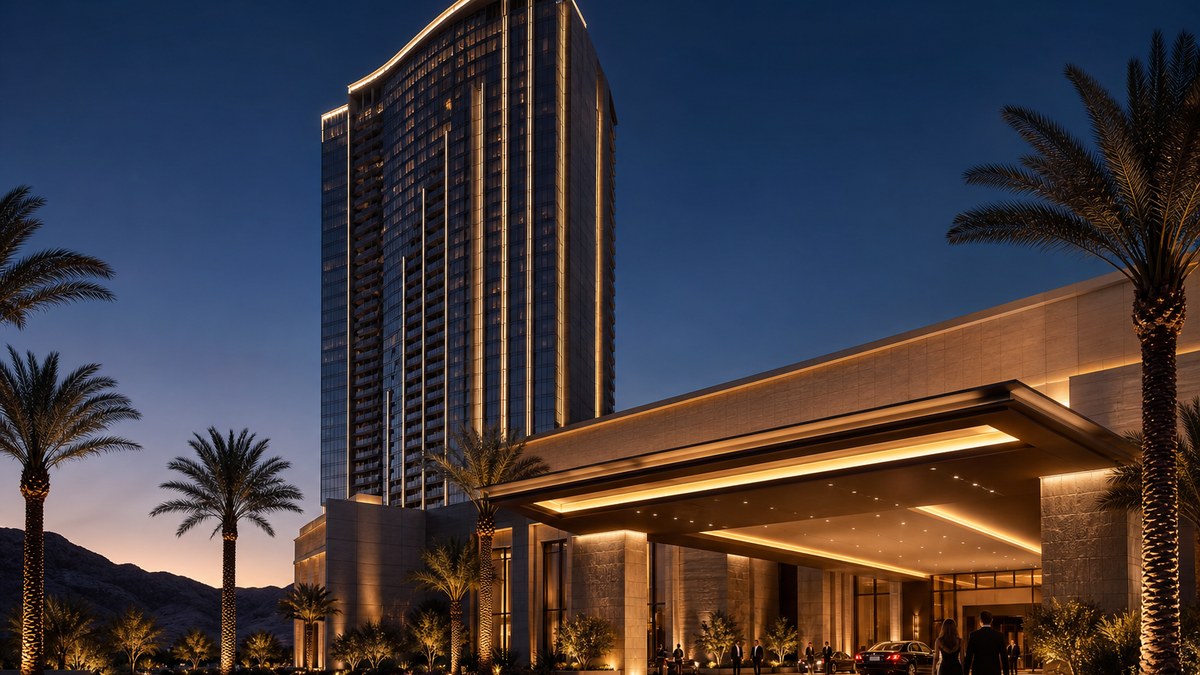
An LED lighting package for a new Las Vegas build is the complete set of luminaires, LED systems, drivers, controls and related equipment for a project, specified by the design team and priced as one coordinated scope during bidding. On a resort, casino, hotel or large commercial building, it usually spans interior architectural and decorative lighting, exterior and facade lighting, site and landscape lighting, and the lighting control system, with signage and video displays either folded in or carried as separate packages. The package is defined by the drawings and specifications, priced through manufacturers' representatives and distribution to the electrical contractor, and protected (or lost) during value engineering.
Quick answer
A new-build LED lighting package in Las Vegas includes every specified luminaire and LED system on the lighting schedule, plus drivers, power supplies, mounting hardware, the lighting control system and commissioning support. It is written into Division 26 of the specifications (typically interior lighting, exterior lighting and lighting controls), issued with a basis-of-design product for each fixture type, and bid with approved equals, alternates and substitution rules. For projects permitted in unincorporated Clark County since January 11, 2026, the package must also meet the 2024 IECC with local amendments. We do not publish prices: every package is quoted to its own drawings, quantities and schedule.
We are a Las Vegas team that coordinates design-assist, product supply and licensed installation for large LED lighting, signage, facade and display projects, and we price lighting packages for owners, architects and general contractors. The major projects mentioned later in this article, such as the Hard Rock redevelopment and the Athletics ballpark, are referenced from public reporting only; we are not involved in them and did not design or build them.
What "lighting package" means on a big Las Vegas job
On a small tenant improvement, lighting is just another line on the electrical bid. On a resort tower, a casino podium or a large mixed-use building, it is a scope of its own: hundreds of fixture types, thousands of luminaires, kilometers of linear LED, a networked control system and a show-lighting layer on the exterior. Because the product cost, lead time and coordination burden are so large, the industry handles it as a package.
In practice the word gets used three ways, and it helps to be clear which one a bid document means:
- The specified package: everything on the lighting fixture schedule and in the lighting specification sections, as drawn by the architect, lighting designer and electrical engineer.
- The quoted package: the bundled quotation a manufacturers' representative or supplier gives the electrical contractor for those products, often covering several manufacturers under one quote.
- The design-build or design-assist package: a scope where the lighting supplier and installer help develop the design, sometimes with a delegated design responsibility, and then deliver it.
Owners and GCs get the best results when they decide early which of these they are buying. A specified package rewards a complete, well-coordinated design. A design-assist package rewards bringing the right partners in before the drawings are finished.
What goes inside a complete LED lighting package
The exact split depends on the project and the design team, but a complete package on a Las Vegas hospitality or commercial new build usually covers the following scopes.
Interior architectural lighting
Downlights, linear slots, coves, wall washers and grazers for lobbies, corridors, guest rooms, meeting space, food and beverage, back-of-house and parking. This is the volume part of the package, and on a hotel it is repeated room after room, so a small change in a guest-room fixture multiplies across the tower.
Decorative and feature lighting
Chandeliers, custom pendants, illuminated ceilings, feature walls and specialty pieces for the lobby, casino, restaurants and nightlife venues. These items are often custom, have the longest lead times and need shop drawings and mock-ups. Many design teams carry them as a separate owner-furnished or interior-design package.
Exterior, facade and building outline lighting
Tower crown and facade lighting, building outline, pixel-mapped media facades, porte-cochere and entry soffits, and podium lighting. On the Strip this is where the identity of the property lives. It needs structural attachment details, wet-location and high-temperature ratings, and a control and data plan, which is why it benefits most from design-assist. Our guide to LED facade lighting and the design-assist timeline covers this scope in depth.
Site, landscape, pool and amenity lighting
Pole and bollard lighting, landscape uplights, step and handrail lights, pool and water-feature lighting, and dayclub or rooftop amenity lighting. Pool and wet-location fixtures carry their own ratings and electrical requirements, so they are usually scheduled separately within the package.
Lighting controls
The networked lighting control system, dimming, scene control, occupancy and daylight sensors, time scheduling, DMX or similar show control for exterior and feature lighting, and the integration points with building management and AV systems. The controls are where most coordination problems hide, and they are also what the energy code inspects most closely.
Emergency and egress lighting
Emergency drivers, inverters or central systems and exit signs. These are life-safety items and are coordinated with the electrical engineer and fire protection team rather than treated as design choices.
Signage, marquees and video (often separate packages)
Exterior LED marquees and pylons, large-format signage, and indoor or outdoor LED video walls are frequently bid as separate packages by sign and display specialists, because they involve structural engineering, sign permits and in Nevada a sign contractor classification. They still have to be coordinated with the lighting package for power, controls, brightness and appearance. See our guides to specifying an LED marquee sign and sportsbook LED video walls, and our LED video walls and modules page.
| Package scope | Typical contents | What drives the effort |
|---|---|---|
| Interior architectural | Downlights, linear, coves, wall washers, guest-room fixtures | Quantity, repetition, finishes, dimming compatibility |
| Decorative & feature | Chandeliers, custom pendants, feature walls | Custom fabrication, shop drawings, mock-ups, lead time |
| Exterior & facade | Crown, outline, media facade, porte-cochere, podium | Structure, heat and UV, pixel mapping, access for service |
| Site & amenity | Poles, landscape, pool, water features, rooftop | Wet ratings, glare control, site coordination |
| Controls | Networked controls, sensors, scenes, show control | Integration, energy code, commissioning |
| Signage & video | Marquees, pylons, video walls (often separate) | Structure, sign permits, content, brightness limits |
Single package or split packages?
One of the first procurement decisions is whether to buy the lighting as one package or as several. There is no universal answer, and the best choice often changes between the tower, the podium and the exterior.
| Approach | Where it works | Watch out for |
|---|---|---|
| Single combined package | One point of responsibility, simpler coordination, consistent controls and finishes | Less competition on each scope; one weak area can drag the whole quote |
| Split by scope | Specialists for decorative, facade and controls; sharper competition | Gaps between packages, especially controls, power supplies and interfaces |
| Owner-furnished decorative | Interior designer controls custom pieces and schedule | Who receives, stores, installs and warranties the items |
| Design-assist exterior | Facade and show lighting developed with supplier input before CDs | Clear scope boundaries and who holds design responsibility |
Rule: whichever way you split it, write down who owns the interfaces. Drivers and power supplies, control wiring, data runs and commissioning are the items most often missed between packages.
How an LED lighting package is specified and bid
The package lives in the drawings and the project manual. On most commercial projects the lighting sections sit in Division 26 of the CSI MasterFormat specifications, typically with separate sections for interior lighting, exterior lighting and lighting controls (for example 26 51 00, 26 56 00 and 26 09 43 for network lighting controls). The fixture schedule on the drawings lists every type, its basis-of-design product, its key performance requirements and the acceptable alternates.
Basis of design and approved equals
Each fixture type is usually written around a basis-of-design product, named so bidders know the performance, look and quality expected. Most specifications then list one or more approved equals and set out how other products can be proposed. The more precisely the performance is written (lumen output, color temperature and rendering, optics, glare control, dimming protocol, finish, ratings and warranty), the easier it is to judge an equal fairly.
The pricing chain
Lighting products generally have no fixed list price on large projects. As lighting designer Jason Livingston explains on Designing Light, the manufacturer and its representative negotiate pricing for each project, and the quoted price is what the electrical distributor pays, before the distributor's, electrical contractor's and general contractor's markups, taxes and freight. That is why early budgets for lighting are hard to pin down and why a package can move a long way between design-assist and the final bid.
Substitutions and value engineering
Bidders may propose substitutions to hit a number. Livingston notes that contractors sometimes bid low on the assumption that cheaper substitutions will be accepted, which leads to conflicts when the designer rejects them. A clear substitution procedure, with deadlines, required data and side-by-side comparisons, protects everyone: the owner gets real competition, the designer keeps the intent, and the contractor knows the rules before pricing.
Alternates, allowances and lead times
Owners can price options without redesigning by asking for alternates (for example, a premium facade show system as an add, or a simpler guest-room fixture as a deduct). Allowances can hold a place for decorative pieces that are not yet selected. Every quote should also state lead times, because custom decorative and facade products can drive the construction schedule.
Pricing a lighting package for a new Las Vegas build?
Send the fixture schedule, specifications or plan-room link. We review scope and interfaces, flag gaps and lead-time risks, and prepare a package proposal that names the products and the licensed installing contractor. Design teams can bring us in earlier for design-assist and budget guidance.
The 2024 energy code and what it means for the package
Nevada's Office of Energy adopted the 2024 International Energy Conservation Code by reference, and Clark County adopted local amendments to it. According to the county's amendment document, the Clark County Commission adopted the amendments on July 15, 2025, and the 2024 IECC with those amendments took effect in unincorporated Clark County on January 11, 2026. That jurisdiction covers most of the Las Vegas Strip. The City of Las Vegas, Henderson and North Las Vegas adopt codes on their own schedules, so confirm the edition in force with the building department for your site.
Several of the county amendments touch lighting packages directly:
- Casino gaming areas excluded from interior lighting power: the amendments add casino gaming areas, and theme or entertainment elements in casinos and theme parks, to the list of lighting excluded from the total connected interior lighting power calculation.
- Exterior theme elements excluded: theme and entertainment elements in casinos are also excluded from the exterior lighting power calculation.
- Daylight-responsive controls: toplit and sidelit zones must be controlled independently, sidelit zones on different orientations separately, and daylight controls must dim continuously down to 15 percent or lower and be able to turn the lights fully off.
- Display and accent lighting controls: accent, display and display-case lighting and supplemental task lighting need an occupancy sensor or time switch, plus a separate manual control.
- Interior parking: luminaires within 20 feet of perimeter wall openings must reduce power by at least 50 percent in response to daylight, with listed exceptions.
The exclusions do not mean the rest of a resort escapes the code. Guest rooms, corridors, back-of-house, meeting space, parking and ordinary exterior lighting still have to meet lighting power and control requirements, and the controls must be commissioned. Build the compliance path into the package from schematic design rather than discovering it at plan review.
Lesson: the energy code is now a controls problem as much as a wattage problem. The package that passes plan review is the one whose control zones, sensors and sequences were drawn on purpose.
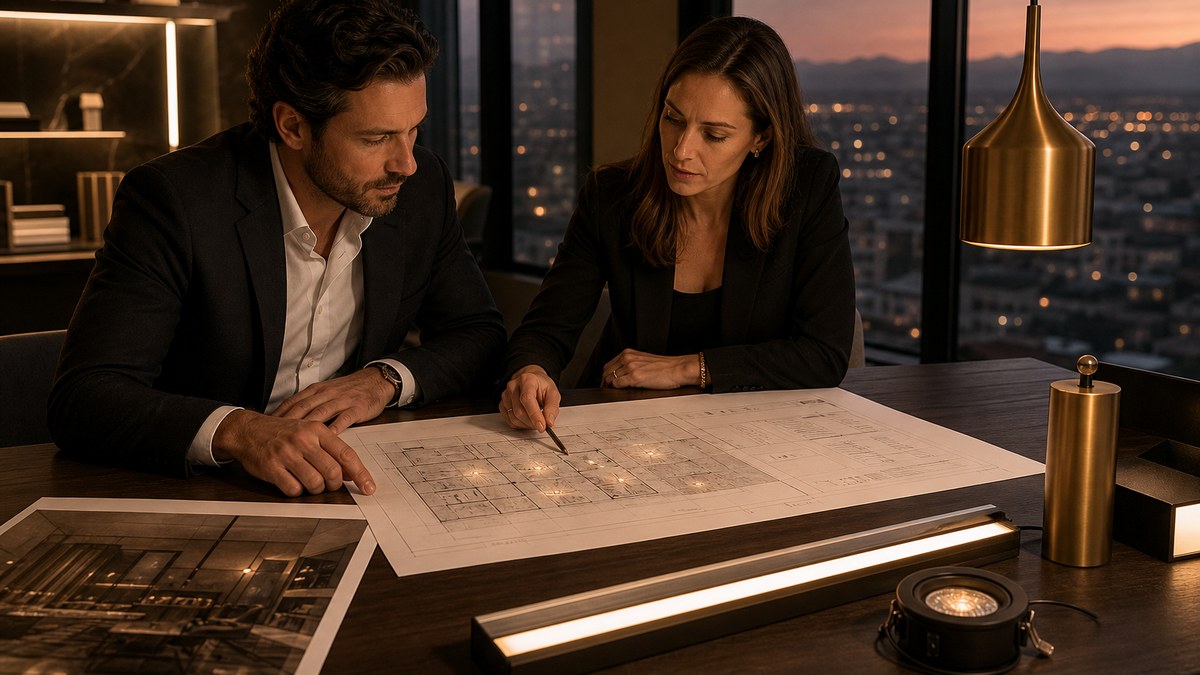
When each part of the package gets decided
The lighting package is not designed in one step. It firms up across the design phases, and the earlier a decision is made, the cheaper it is to change.
| Phase | Lighting decisions | Who should be at the table |
|---|---|---|
| Concept & schematic design | Lighting concept, exterior identity, facade approach, budget order of magnitude, code path | Owner, architect, lighting designer, design-assist partner |
| Design development | Fixture families, mock-ups, structure and power for facade and feature lighting, controls architecture | Lighting designer, electrical and structural engineers, supplier input |
| Construction documents | Final fixture schedule, specifications, control narrative, alternates and substitution rules | Electrical engineer, lighting designer, specifier |
| Bidding & buyout | Package quotes, equals and substitutions, lead times, scope interfaces | GC, electrical contractor, suppliers, design team for reviews |
| Construction & closeout | Submittals, mock-up approval, installation, aiming, programming, commissioning, spares | Installing contractor, controls programmer, owner's operations team |
Value engineering without losing the design
Almost every large lighting package goes through a round of value engineering. Done well, it finds real savings; done badly, it swaps out the products that made the renderings look the way they did. A few principles keep the result close to the design intent:
- Protect what guests see first: the facade, the arrival sequence, the lobby and the casino are where light sells the property. Look for savings in back-of-house, corridors and repeat fixtures before cutting feature lighting.
- Compare performance, not only cutsheets: equal products should match output, color quality, optics, glare control, dimming smoothness, finishes and warranty. Ask for photometric files and samples.
- Mock up the questions: a mock-up at the real distance settles color temperature, glare and appearance faster than any spreadsheet.
- Keep the controls whole: splitting control systems or mixing dimming protocols to save on hardware often costs more in programming, troubleshooting and energy-code compliance.
- Think about the next twenty years: service access, spare parts and the likelihood a product line will still exist matter on a building that runs around the clock. Order attic stock from matched batches.
The Las Vegas new-build pipeline
Large new builds and full redevelopments are what make lighting packages a distinct scope in this market. Two current examples, both from public reporting and neither involving our team:
- Hard Rock Las Vegas: the former Mirage site on the Strip is being redeveloped, including a 42-story, 675-room Guitar Hotel, with opening reported for late in the second half of 2027 (Las Vegas Review-Journal, via CDC Gaming, June 2026).
- The Athletics ballpark: a 33,000-seat domed ballpark on the Strip, built by Mortenson-McCarthy, with foundation work reported complete in February 2026 and opening targeted before the 2028 season (Associated Press, via KOLO).
Projects of this size are usually followed by a wave of nearby work: renovations, tenant build-outs, signage and exterior refreshes, and new hospitality and commercial buildings. Each of those has its own lighting package, and the teams that win them are the ones engaged while the drawings are still moving. Our look at the biggest LED projects in Las Vegas shows what the landmark exteriors in this market look like when the design and the lighting are developed together.
Licensing, permits and who does what
In Nevada, contracting work requires a license from the Nevada State Contractors Board in the right classification, such as C-2 for electrical work and C-6 for signs, and every bid must fall within the licensee's monetary limit. Lighting installation is electrical work, so the lighting package is installed under the electrical contractor's license and permits with Clark County or the relevant city. Exterior signs and marquees in the package, or alongside it, also go through sign permitting.
On our projects, installation is performed by licensed, insured contracting partners, and every proposal names the licensed contractor performing the work. Our licensed installation partner has completed 200+ major sports and commercial projects across the US and Canada (NFL, NBA, NHL, MLS, NCAA, NASCAR venues), and we bring 15+ years as an authorized architectural lighting dealer and project coordinator. For design and documentation, including design-assist and design-build scopes, we work with architecture and engineering partners.
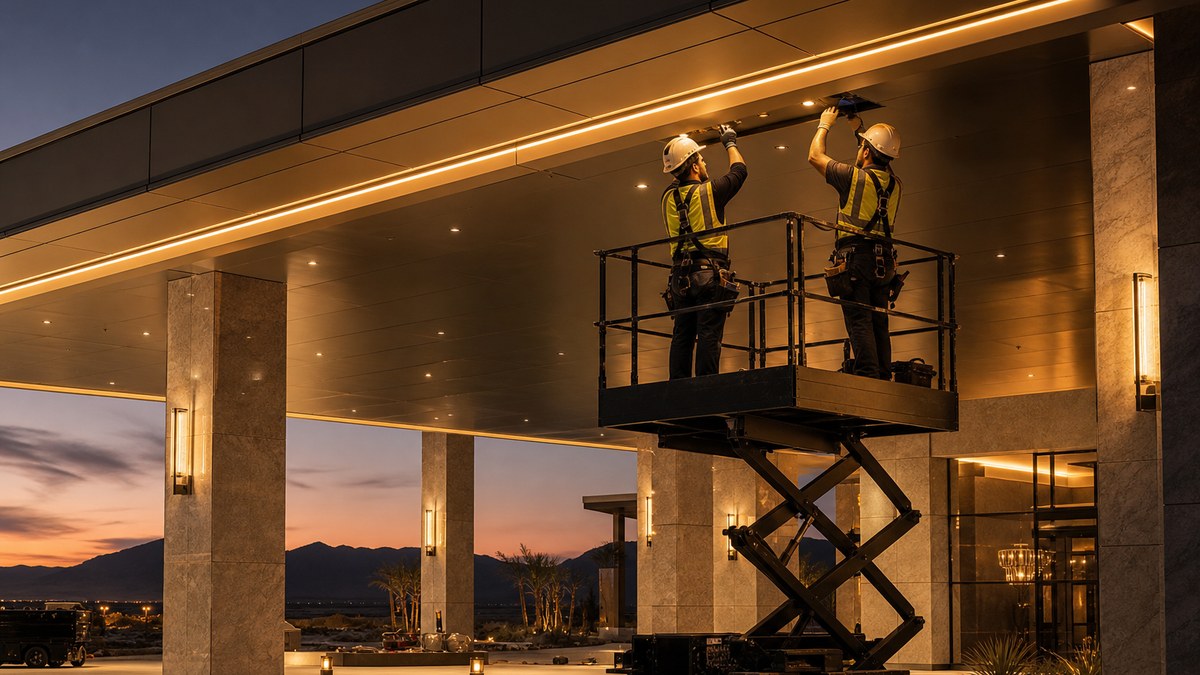
A lighting package checklist for owners, architects and GCs
- Decide the procurement model: single package, split packages, owner-furnished decorative or design-assist exterior.
- Freeze one fixture schedule: every type, basis of design, performance requirements and approved equals in one document.
- Write the substitution rules: deadline, required data, samples and photometrics, and who approves.
- Define the interfaces: drivers, remote power supplies, control wiring, data runs, show control and integration with AV and building systems.
- Confirm the code path: edition in force for the jurisdiction, lighting power and controls compliance, and commissioning requirements.
- Coordinate structure and power early: especially for facade, outline, feature and sign lighting.
- Price alternates, not redesigns: add and deduct alternates for the scopes most likely to move.
- Ask for lead times with every quote: custom decorative and facade products set the schedule.
- Plan mock-ups: for exterior lighting, key interior spaces and any proposed equals.
- Plan for operations: service access, attic stock, warranty terms, as-built control programming and training for the property team.
If your project includes signage, marquees, facade lighting or video, our pages on LED signs and marquees, architectural facade lighting and hotel and casino LED lighting explain how we support each scope. Design teams can see how we work on the architects and GCs page, and owners with an existing property that needs parts can start with our LED module and parts supply. When you are ready, request a bid or browse more insights.
Frequently asked questions
What is included in an LED lighting package for a new building?
A lighting package includes every luminaire and LED system on the fixture schedule, plus drivers, power supplies, mounting hardware, the lighting control system and commissioning support. On a resort or casino it usually covers interior architectural, decorative, exterior and facade, site and amenity lighting, with signage and video often bid as separate packages.
Who buys the lighting package on a commercial project?
On most bid projects the electrical contractor buys the lighting package from manufacturers' representatives and distributors under the general contractor's contract. Owners sometimes buy decorative fixtures directly as owner-furnished items, and design-assist or design-build exterior packages may be contracted earlier.
Where is lighting specified in construction documents?
Lighting is usually specified in Division 26 of the CSI MasterFormat specifications, typically in separate sections for interior lighting, exterior lighting and lighting controls, together with the lighting fixture schedule on the electrical drawings.
What does basis of design mean in a lighting specification?
Basis of design is the named product a fixture type was designed around. It sets the expected performance, appearance and quality. Specifications usually list approved equals and describe how other products can be proposed as substitutions.
Which energy code applies to new lighting in Las Vegas?
Nevada adopted the 2024 IECC, and Clark County's amended version took effect in unincorporated Clark County, which includes most of the Strip, on January 11, 2026. The City of Las Vegas, Henderson and North Las Vegas adopt on their own schedules, so confirm with the building department for your site.
Is casino lighting exempt from the energy code in Clark County?
Not entirely. Clark County's 2024 IECC amendments exclude casino gaming areas and casino theme or entertainment elements from the interior lighting power calculation, and theme elements from exterior lighting power. Other spaces such as guest rooms, corridors, parking and back-of-house still have to comply, including control requirements.
Should facade lighting be in the main lighting package?
It can be, but facade, outline and media lighting benefit from design-assist because they need structural details, power and data planning, show control and mock-ups. Many teams develop the exterior with a specialist early and either fold it into the main package or bid it separately with clear interfaces.
How do you value engineer a lighting package without ruining the design?
Protect the spaces guests see first, compare substitutions on measured performance and samples rather than cutsheets, mock up the key questions, keep the control system whole, and look for savings in repeated and back-of-house fixtures before feature lighting.
How much does an LED lighting package cost for a new Las Vegas build?
We do not publish prices. A package depends on fixture types and quantities, custom and decorative items, exterior and facade scope, controls, lead times, labor and schedule. Every package is quoted to its own drawings and specifications, and budget guidance is available during design-assist.
Related
Sources
- Clark County, 2024 IECC Code Amendments (adopted July 15, 2025; effective January 11, 2026).
- Nevada Governor's Office of Energy, IECC Notice of Adoption 2024.
- Jason Livingston, Designing Light, Fixture Cost Frustration and related posts on substitutions and specifications.
- Example Division 26 specification sections: Section 26 09 43, network lighting controls (State of Wisconsin master specification).
- CDC Gaming / Las Vegas Review-Journal, Rocking the Strip: Hard Rock casino, Guitar-shaped hotel rising in Las Vegas (June 2026).
- KOLO / Associated Press, A's: Foundation work complete on Las Vegas stadium and opening still targeted for 2028 (February 2026).
- Nevada Administrative Code 624.200 and 624.240 (classifications) and Nevada State Contractors Board licensing requirements.
Las Vegas LED Lights is independent and is not affiliated with the properties, developers, contractors or teams named in this article, and is not working on those projects. Code information is a summary for planning purposes; confirm requirements with the authority having jurisdiction and your design team. All images in this article are illustrations, not photographs of real projects.