Home / Insights / LED marquee retrofits in Las Vegas
LED Signs & Marquees · Retrofit Guide
LED marquee retrofits in Las Vegas, repair, re-face or replace an aging sign
A decision guide for resort and casino owners, facilities teams, architects and general contractors: how to tell whether an aging LED marquee or video wall needs module repair, a new LED face on the existing structure, or a full replacement, and what a bid-ready retrofit proposal should show before anyone climbs the pylon.
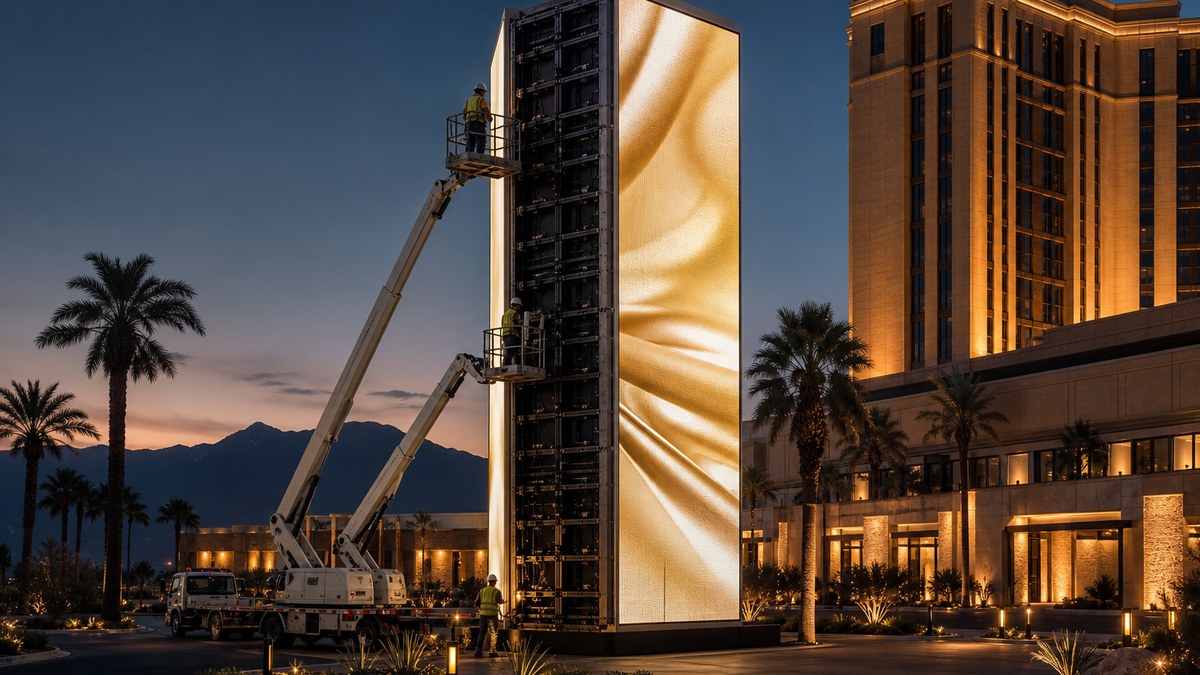
An LED marquee retrofit in Las Vegas is the upgrade of an existing marquee, pylon or building-mounted video display, and it usually takes one of three forms: repairing or replacing failed modules and electronics, re-facing the sign with new LED display faces on the existing structure, or replacing the marquee outright. Which one is right depends on the condition of the steel and foundation, whether matching parts still exist, how the display has aged, what the property wants the sign to do for the next decade, and what the authority having jurisdiction will require once the work counts as more than maintenance.
Quick answer
Repair when the structure is sound, failures are isolated and matching modules, power supplies and receiving cards are still available. Re-face when the steel, foundation and power are good but the LED faces are obsolete, uneven or too coarse for today's content. Replace when the structure, foundation or layout no longer fits the property, or when the sign's size, position or orientation should change. In every case, start with a condition survey, confirm parts availability in writing, check with Clark County or the city whether the work needs a sign or building permit, and make sure the proposal names the licensed contractor who will do it.
We are a Las Vegas team that coordinates design-assist, product supply and licensed installation for large LED lighting, signage, facade and display projects, working with architecture and engineering partners and licensed, insured contracting partners. The Strip and downtown projects mentioned in this article, including the marquees at Caesars Palace, Harrah's Las Vegas, Paris Las Vegas, Planet Hollywood, The LINQ Promenade and MGM Grand, the Fremont Street Experience canopy and the Peppermill sign, are referenced from public reporting only. We did not design, supply or build them, and we are not affiliated with those properties or the companies that did the work.
Why marquee retrofits are now a constant on the Strip
A Las Vegas marquee is not a sign in the ordinary sense. It is a piece of advertising inventory, a wayfinding landmark and part of the resort's architecture, and it runs in some of the harshest conditions any display faces: direct desert sun, summer heat that reached 120°F at Harry Reid International Airport on July 7, 2024, wind-blown dust and long daily hours of operation. LED technology has also moved quickly. A marquee installed fifteen years ago may still light up, but its pixel pitch, color uniformity, brightness control and content system can look dated next to a newer neighbor across the boulevard.
That is why the Strip's marquees are rebuilt, re-faced and upgraded on a rolling basis rather than once a generation. Public reporting shows the pattern clearly:
- In late 2018 and early 2019, Caesars Entertainment, Las Vegas sign company Vision Sign and Daktronics renovated marquees at four Strip properties, adding more than 21,000 square feet of LED video. At Paris Las Vegas, LED video replaced the previous stationary flex faces in the basket beneath the Balloon Monument Marquee, and at Caesars Palace the static and digital screens swapped positions with two new video sides (Daktronics, March 2019).
- In spring 2026, The LINQ Promenade's three-sided, 130-foot pylon went through what Signs of the Times called a top-to-bottom renovation over about three months, with construction starting in early March and the reimagined marquee unveiled in mid-May (Signs of the Times; FOX5, May 2026). FOX5 described larger screens on the south-facing and pedestrian-facing sides and structural updates to support long-term use.
- In June 2026, a new 210-foot-tall, 62-foot-wide Caesars Palace marquee with a 16 mm pixel pitch was completed at Flamingo Road and Las Vegas Boulevard, designed, engineered, fabricated and installed by YESCO with Branded Cities (FOX5, June 2026; Billboard Insider, July 2026).
- Downtown, the Fremont Street Experience's Viva Vision canopy was refreshed in phases from 2019, to roughly 130,000 square feet of LED and 16.3 million pixels (Sixteen:Nine, 2018).
The lesson for any owner is not that every marquee must be replaced, but that the decision is a planned capital project with engineering, permitting and phasing, not a maintenance ticket. The same logic applies to building-mounted displays, porte-cochere screens, casino entrance signs and the large interior video walls covered in our LED video wall guide.
Three paths: repair, re-face or replace
Almost every retrofit lands on one of three paths. They are not equally visible from the street, and they do not carry the same engineering, permitting or schedule burden.
| Path | What changes | What stays | Best when | Watch for |
|---|---|---|---|---|
| Repair and refresh | Failed modules, power supplies, receiving cards, fans, gaskets, controllers; calibration | Structure, cabinets, display faces, layout | Failures are isolated, the image still meets the brand standard and parts can be matched | Batch mismatch on new modules, parts that are no longer made, repeated failures that point to a design problem |
| Re-face (new LED faces on the existing structure) | LED cabinets or display faces, processing, often power distribution and data; sometimes static faces become video | Foundation, primary steel, sign location and much of the silhouette | The structure and foundation check out, but the LED is obsolete, uneven or too coarse | Added weight and wind area, new cabinet dimensions, secondary steel, electrical capacity, permit triggers |
| Replace | Everything above ground, often the foundation too | The site and the sign's role on the property | The structure is near the end of its life, or the sign should grow, move, turn or change shape | Longest schedule, full engineering and permits, demolition and removal of the old sign |
A fourth option sits outside the three: relocation. Some display makers suggest moving an aging display to a less visible position on the property and putting new technology where the audience is (Daktronics digital billboard upgrade guidance). On a resort campus, that might mean a retired marquee face becomes a back-of-house or parking-structure display while the Strip-facing position gets the new one.
Rule: decide which path you are on before you ask for numbers. A repair quote, a re-face proposal and a replacement bid are three different scopes, and comparing them side by side only works when each one states what it keeps and what it changes.
Step 1: survey the marquee before choosing a path
Most bad retrofit decisions start without a proper condition survey. A walk-by at night shows dark modules and color shifts; it does not show corroded connections, overheated power supplies, loose secondary steel or a cabinet that has been letting dust in for years. A useful survey covers five things.
The structure and foundation
Primary steel, secondary steel, connections, anchor bolts, catwalks and access ladders, and the foundation. Ask for the original structural drawings and calculations if they exist. A structural engineer should review any plan that adds weight, adds wind area, changes the face size or changes the way loads reach the foundation. A re-face that looks like a simple swap from the sidewalk can still change the loads on a pylon that was designed around older, heavier or smaller cabinets.
The display faces
Count dead pixels and dark modules, map color and brightness differences between cabinets, and note which areas see the most sun. LED output declines with operating hours, heat and UV exposure, so south- and west-facing faces usually age first. Industry practice measures LED lumen maintenance with tests such as LM-80 and projects long-term life with TM-21, and those numbers explain why two faces of the same marquee can look different after years of different sun exposure.
Power, data and controls
Power supplies, distribution, disconnects, grounding, surge protection, fiber or copper data runs, sending and receiving cards, the content player and the scheduling system. Older processing may not support the resolution, color depth or remote monitoring a new face would need. Power distribution may also need upgrading if the new face draws differently or if static faces become video.
Environmental protection and cooling
Gaskets, seals, filters, fans and air conditioning in walk-in cabinets. In the Mojave, dust and heat are the two failure drivers that show up again and again. IEC 60529 ratings tell you what the cabinet was designed to resist (IP6x is dust-tight, x5 and x6 cover water jets), but a twelve-year-old gasket is not the gasket that earned the rating.
Parts availability
Ask the manufacturer or its distributor, in writing, which modules, power supplies, receiving cards and controllers are still made, which are in stock, and which are discontinued. Display makers themselves note that replacement parts are not guaranteed indefinitely and suggest checking availability and stocking key components before an older display needs them (Daktronics). This one answer often decides between repair and re-face.
Step 2: when repair is the right answer
Repair is often the right first move. If the structure is sound, the image still meets the brand standard, and failures are isolated to a few modules, power supplies or fans, a targeted repair and calibration can carry the marquee for years. Good repair work on a large marquee usually includes:
- Replacing failed modules from matched spare stock, not from whatever is on the shelf.
- Replacing tired power supplies and fans proactively in the hottest cabinets, not only the ones that failed.
- Cleaning, re-sealing and replacing gaskets and filters to restore dust and water protection.
- Checking data connections and receiving cards, and updating firmware where the manufacturer supports it.
- Running a brightness and color calibration so repaired areas blend with the rest of the face.
- Setting up remote monitoring and a spare-parts inventory so the next failure is a swap, not an emergency.
The batch-matching problem
The single most common surprise in marquee repair is that new modules do not match old ones. LEDs are sorted into bins by color and brightness at the factory, and every cabinet in a display has to match its neighbors or the image shows patches. As Neoti's chief technology officer explained in Systems Contractor News, identical panels usually cannot be made later unless the manufacturer still holds stock from the original batch, and runtime, UV exposure and materials change output over time anyway (AVNetwork, November 2022). His advice: buy spares from the same batch at the start, including diodes and the black plastic masks, and if unmatched panels must be added, group them together in one area or row rather than scattering them. ROE Visual gives similar guidance: new panels are not guaranteed to match, buying from the same batch is the first choice, and older or heavily used panels may need a custom calibration to match.
Lesson: if the original spare stock is gone and the manufacturer cannot supply matched modules, a "repair" can leave a marquee looking patched in full view of the Strip. That is often the moment a re-face becomes the better value, even if the structure has many years left.
We help source compatible LED modules, receiving cards and power supplies for existing displays where they are still available; see the LED module supply section of our video walls page.
Step 3: when a re-face makes more sense
A re-face keeps the foundation, the primary steel and usually the sign's silhouette, and replaces the LED faces and their electronics. On the Strip, re-faces and partial rebuilds are common because the location of a marquee is often as valuable as the sign itself, and keeping the structure can avoid the longest parts of a full replacement. The 2018–2019 Paris Las Vegas work, where LED video replaced stationary flex faces beneath an existing monument marquee, is a public example of changing what a sign face does without changing the landmark around it.
A re-face is usually the right call when:
- The structure and foundation survey comes back sound, with capacity for the new faces.
- Matched replacement modules are no longer available, or the face is too uneven to calibrate.
- The pixel pitch is too coarse for the content the property now runs, such as live feeds, fine typography or high-resolution brand content.
- Static or backlit faces should become video, or the property wants to add a video side.
- Energy, brightness control or remote monitoring on the old face is well behind current equipment.
What has to be engineered in a re-face
New LED cabinets almost never share the exact dimensions, weight and mounting points of the old ones. A re-face usually needs new or modified secondary steel to carry the cabinets, a structural check of the primary steel and foundation for any change in weight or wind area, a power review and often new distribution, new data and processing, and a service-access plan. Front-service cabinets can simplify maintenance on a building-mounted display with no walk-in space behind it; rear-service cabinets suit pylons with a catwalk or walk-in cabinet. Decide that early, because it changes the steel.
The face size is also a design question, not only an engineering one. Most properties use a re-face to gain resolution, not just brightness, and pixel pitch should follow the viewing distance. Planar's rule of thumb is that pixel pitch in millimeters times ten gives the approximate viewing distance in feet. A Strip-facing marquee read from vehicles and across the boulevard can use a coarser pitch than a porte-cochere screen read by guests a few feet away. The new Caesars Palace marquee, at 16 mm, is a public reference for a very large Strip-facing face; our LED marquee specification guide covers pitch, brightness and structure in more depth.
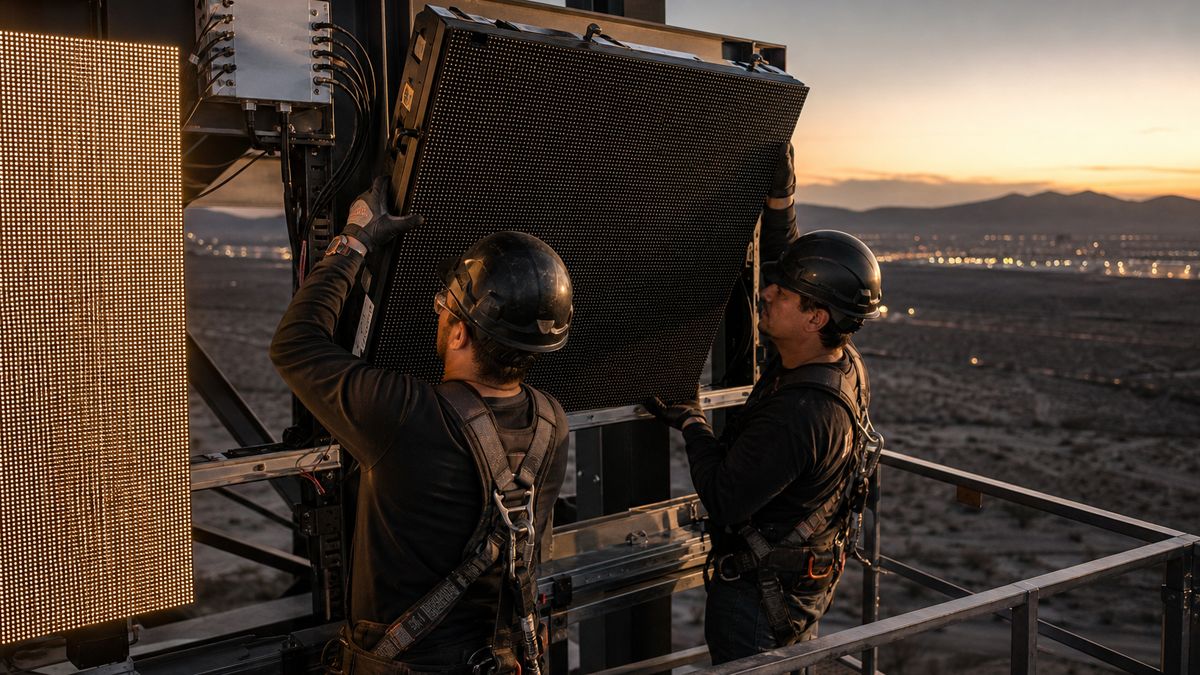
Step 4: when replacement is the only sound option
Replacement is the right answer when the structure itself is the problem or the sign no longer fits the property. Typical triggers include:
- Corrosion, fatigue or foundation issues that make strengthening impractical.
- A property renovation or rebrand that changes the entry, the porte-cochere or the sign's relationship to the building.
- A larger face, a new shape, a different orientation or an added side that the existing steel or foundation cannot carry.
- A new road, pedestrian bridge or neighboring building that changes the sightlines the sign was designed around.
- A sign so integrated with obsolete systems that the retrofit would replace almost everything anyway.
Replacement brings the full process: design, structural engineering, foundation design, permits, fabrication, demolition and removal of the old sign, installation, commissioning and content. It also raises a question many Las Vegas owners care about: what happens to the old sign. When the Peppermill on the Strip replaced its street-side marquee with an LED sign in 2018, the original sign was slated to go to the Neon Museum (KTNV, April 2018). For signs with history, plan the removal so the original elements can be preserved, documented or donated, and build that into the schedule.
Retrofitting a large LED video wall or building-mounted display
The same three paths apply to large video walls on a building or inside a resort: sportsbook walls, lobby features, promenade displays and porte-cochere screens. Inside, the constraints are usually ceilings, finishes, sightlines and the fact that the space stays open. Outside, they are structure, weather and street visibility. A few points are specific to walls:
- Expansion vs replacement. Adding cabinets to an aging wall rarely matches. If a wall needs to grow, plan whether the whole face should be replaced at once.
- Pitch upgrades change content. A finer pitch on the same footprint means more pixels, which may need new processing, new content templates and a new layout for feeds and branding.
- Technology choice affects service. SMD faces allow finer-grained repairs; COB faces are resin-coated, more impact- and dust-resistant and are usually repaired at the module level. That trade-off matters on a promenade wall guests can touch.
- Interior code. In unincorporated Clark County, the 2024 IECC amendments adopted in 2025 exclude casino gaming areas and casino theme and entertainment elements from interior lighting power density; confirm with the design team how the jurisdiction treats a new display in its location.
For sportsbook walls specifically, see sportsbook LED video walls in Las Vegas.
Planning a marquee or video wall retrofit on a Las Vegas resort, casino or commercial property?
Send photos, the original drawings if you have them, an RFP or a short description of the sign and the goal. We will help scope the condition survey, compare repair, re-face and replacement, and prepare a bid-ready proposal with the licensed contractor named.
Permits, licensing and code for marquee retrofits in Southern Nevada
Permits and licensing depend on where the sign is, what is being changed and whether the work counts as maintenance or a new installation. These points apply to most retrofit projects; confirm the specifics with the authority having jurisdiction and your design team.
- Jurisdiction. Most of the Strip is in unincorporated Clark County; downtown is in the City of Las Vegas; Henderson and North Las Vegas have their own departments. Each sets its own sign rules and permit process.
- When a permit is likely. Like-for-like module and power-supply replacement is often treated as maintenance, while new faces, changes in size or height, conversion of static faces to video, structural changes and new electrical service generally need review. Ask the jurisdiction before scoping, not after.
- Contractor licensing. Nevada requires an active Nevada State Contractors Board license for contracting work. The C-6 classification covers signs and C-2 covers electrical (NAC 624.200 and 624.240), and bids must be within the licensee's monetary limit. The NSCB advises owners to confirm the license is valid and active, that the work is within the license classification (NRS 624.3015(2)), and that the bid is within the licensee's limit (NRS 624.305), using the public license search on the NSCB website.
- Electrical code. Under NEC Article 600, signs must be listed and installed according to their listing (600.3), and a disconnect is required within sight of the sign (600.6). A re-face that introduces new cabinets and power supplies should be reviewed against the listing and the disconnect arrangement.
- Engineering. Structural changes, new secondary steel and new foundations need engineering by an appropriately licensed design professional, sealed where the jurisdiction requires it. The City of Las Vegas commercial submittal checklist, for example, calls for plans drawn by a Nevada-registered architect or engineer and electrical load calculations.
Rule: every retrofit proposal should say in plain words whether the scope needs a permit, who will pull it, and which licensed contractor, by name and classification, will do the work.
Phasing a retrofit on a property that never closes
A Las Vegas marquee cannot go dark for a season, and neither can the driveway, sidewalk or porte-cochere around it. Retrofit planning has to answer four practical questions early.
Which faces go first
Three- and four-sided marquees can usually be re-faced one side at a time, so at least one face keeps running content. Building-mounted displays can sometimes be split into zones. Sequence the faces around the property's event calendar and the media commitments sold on the sign.
Where the crane goes and when
Crane and lift positions affect traffic lanes, sidewalks, rideshare zones and valet. Most heavy lifts on the Strip are planned for overnight windows and require coordination with the jurisdiction and the property's security and transportation teams. Build traffic control and lift plans into the proposal, not into a change order.
How content keeps running
If new processing replaces the old, plan the cutover: content formats, scheduling, ad delivery and remote monitoring. If the sign carries sold advertising, the media sales team needs the outage plan before the contract is signed.
Who owns the punch list
Commissioning should include brightness and color calibration across every face, light-sensor dimming at night, verification of the disconnect and grounding, a spare-parts kit from the new batch, and training for the facilities team. The 2026 LINQ Promenade project, renovated over about three months with structural updates for long-term use, is a reminder that schedule, structure and the content plan are planned together.
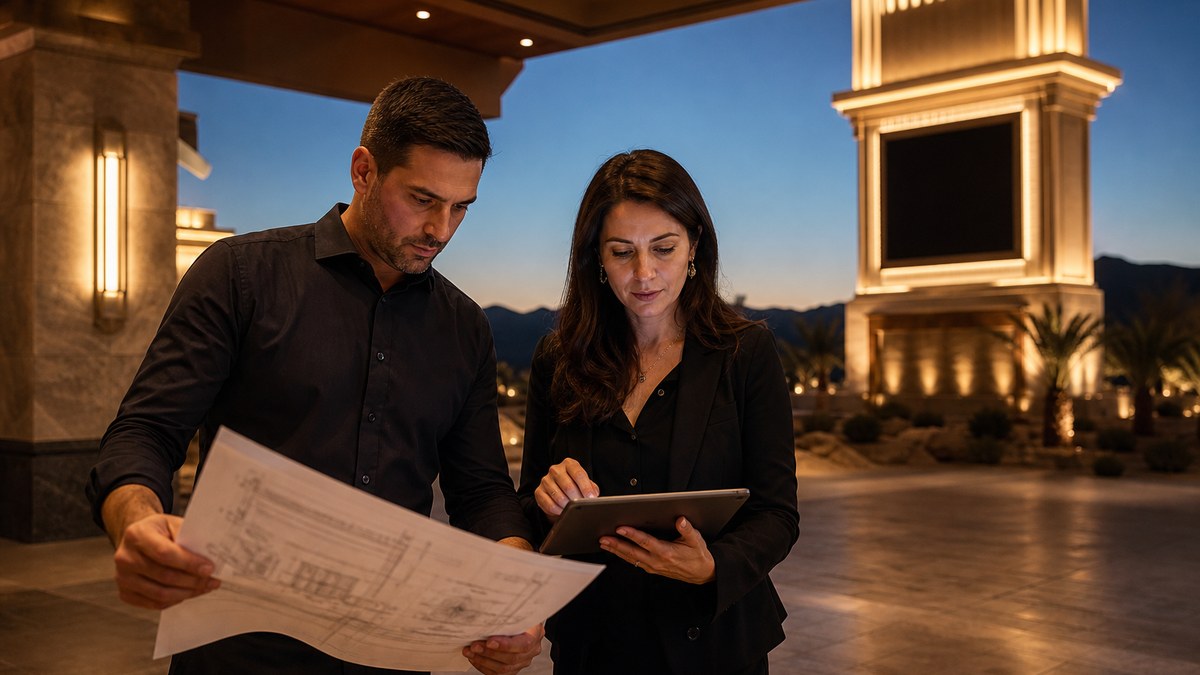
What drives the scope and cost of a marquee retrofit (without prices)
We do not publish prices, and no responsible bid can be priced before a survey. These are the factors that move the number, roughly in order of impact:
| Factor | Why it matters |
|---|---|
| Path chosen | Repair, re-face and replacement are different orders of work; the structure and foundation decide which is possible. |
| Active LED area and number of faces | More faces and more square feet mean more cabinets, power, data and labor. |
| Pixel pitch | Finer pitch means more LEDs, more processing and usually more power per square foot. |
| Structural work | New secondary steel, strengthening or a new foundation can outweigh the display itself. |
| Electrical service | New distribution, disconnects or service capacity add scope and permits. |
| Access and height | Tall pylons, cranes, overnight work windows and traffic control add time and equipment. |
| Phasing | Keeping faces live, working around events and protecting guests add sequence and coordination. |
| Removal and preservation | Demolition, disposal or careful removal of a historic sign for preservation. |
| Content and controls | New processing, content templates, ad delivery and monitoring software. |
| Spares and service | A matched spare-parts inventory and a service agreement protect the investment. |
A marquee retrofit checklist for owners, architects and GCs
- Gather what exists: original drawings, structural calculations, electrical drawings, manufacturer, model and install date, and service records.
- Commission a condition survey of structure, foundation, faces, power, data, cooling and seals.
- Get parts availability in writing for modules, power supplies, receiving cards and controllers.
- Define the goal: same look restored, higher resolution, video where faces were static, a new side, or a new sign.
- Choose the path (repair, re-face, replace or relocate) and write it into the scope.
- Ask the jurisdiction which permits apply and confirm who will pull them.
- Engage structural and electrical engineering for anything that changes loads, faces or service.
- Set the pixel pitch from viewing distance and the brightness range from orientation and sun exposure.
- Plan phasing, crane and lift positions, traffic control and the content cutover.
- Require a named, licensed contractor with the right NSCB classifications and monetary limit.
- Specify commissioning: calibration, dimming, disconnect and grounding checks, training and documentation.
- Order matched spares from the new batch and set up a service and monitoring plan.
How to compare retrofit proposals
Retrofit proposals are harder to compare than new-sign bids because each one makes assumptions about the existing structure. Line them up on these points:
- Survey basis. Did the bidder inspect the sign, or price from photos? What did the survey find?
- What stays and what changes. Foundation, primary steel, secondary steel, cabinets, power, data and controls, item by item.
- Engineering. Who performs and seals the structural and electrical engineering, and is it in the price?
- Display specification. Pixel pitch, active area per face, brightness range, dimming method, ingress rating, service access and cooling.
- Parts and spares. Matched spare quantities from the new batch and the parts-availability commitment.
- Permits. Which permits are included and who pulls them.
- Phasing and access. Lift and crane plans, overnight work, traffic control and how many faces stay live.
- Removal. Disposal, salvage or preservation of the old faces and structure.
- Licensed contractor. Named company, NSCB license number and classifications, and monetary limit.
- Warranty and service. What is covered, for how long, response times and remote monitoring.
Where we fit
Las Vegas LED Lights helps owners, facilities teams, architects, lighting designers and general contractors plan and deliver LED marquee and video wall retrofits as part of larger lighting, signage and facade scopes, and supplies LED modules and parts where matching components are still available. We bring 15+ years as an authorized architectural lighting dealer and project coordinator, and our licensed installation partner has completed 200+ major sports and commercial projects across the US and Canada (NFL, NBA, NHL, MLS, NCAA, NASCAR venues). Design and engineering come through our architecture and engineering partners, and installation is carried out by licensed, insured contracting partners; every proposal names the licensed contractor. Learn more on our LED signs and marquees page, or see how we support hotel and casino LED lighting, architectural facade lighting and design-build and design-assist delivery on the same property.
Frequently asked questions
Should we repair or replace an aging LED marquee in Las Vegas?
Start with a condition survey. Repair when the structure is sound, failures are isolated and matched parts are available. Re-face with new LED cabinets on the existing structure when the steel and foundation check out but the LED is obsolete or uneven. Replace when the structure, foundation or layout no longer fits the property or the sign needs to grow, move or change shape.
What is an LED marquee re-face?
A re-face replaces the LED display faces and their electronics while keeping the foundation, the primary steel and usually the sign's silhouette. It typically needs new secondary steel, a structural check, power and data upgrades and new processing, because new cabinets rarely match the old ones in size, weight or mounting.
Why do new LED modules not match the old ones on our sign?
LEDs are sorted into color and brightness bins in production batches, and older modules have aged with runtime, heat and UV exposure. Identical modules usually cannot be made later unless stock from the original batch remains. Buy matched spares at installation, group any unmatched modules together, and calibrate after repairs.
How long does an LED marquee retrofit take?
It depends on the path. A targeted repair can take days; a re-face or full replacement involves survey, engineering, permits, fabrication and installation. As one public reference, The LINQ Promenade's 130-foot marquee renovation in 2026 took about three months of construction, according to Signs of the Times.
Does a marquee retrofit need a permit in Clark County or the City of Las Vegas?
Often. Like-for-like repairs are frequently treated as maintenance, while new faces, size or height changes, converting static faces to video, structural changes and new electrical service generally need review. Confirm with Clark County, the City of Las Vegas, Henderson or North Las Vegas before finalizing the scope.
What license does a contractor need to retrofit a sign in Nevada?
An active Nevada State Contractors Board license with the right classification, typically C-6 for signs and C-2 for electrical work, with bids inside the licensee's monetary limit. Owners can confirm license status and classification with the public license search on the NSCB website.
Can we keep the marquee running during the retrofit?
Usually, in part. Multi-sided marquees can often be re-faced one side at a time and building displays can sometimes be split into zones, so some content keeps running. Plan the sequence around events and sold media, and schedule heavy lifts for overnight windows.
Can you supply replacement LED modules for an existing marquee or video wall?
Often, yes. We help source compatible LED modules, receiving cards and power supplies for existing displays where they are still available, and advise when matched parts are not available and a re-face is the better path.
How long should an outdoor LED marquee last in the Las Vegas climate?
It depends on the product, brightness settings, heat management, sealing and maintenance. South- and west-facing faces usually age first. One display maker suggests reviewing upgrade options once a digital display is more than ten years old, and regular cleaning, seal replacement and calibration extend useful life.
How much does an LED marquee retrofit cost in Las Vegas?
We do not publish prices. Scope depends on the path chosen, active LED area and number of faces, pixel pitch, structural and electrical work, access, phasing and removal. Send photos, drawings or an RFP through our Request a Bid page and we will help define the scope for a bid.
Related
Sources
- Daktronics, Caesars Entertainment partners with Vision Sign and Daktronics for multiple Las Vegas marquee renovations (March 2019).
- Signs of the Times, New 130-ft marquee on Las Vegas Blvd (May 2026).
- FOX5 Las Vegas, The LINQ Promenade unveils reimagined 130-foot digital marquee (May 2026).
- FOX5 Las Vegas, New Caesars Palace marquee lights up the Las Vegas Strip (June 2026); Billboard Insider, YESCO installs new Las Vegas marquee for Caesars Palace (July 2026).
- KTNV, The Peppermill is getting a new sign (April 2018).
- AVNetwork / Systems Contractor News, Batch Matching: What You Need to Know (November 2022).
- ROE Visual, Will my new LED panels look like my old ones?
- Daktronics, Future-proof your OOH business (digital billboard upgrade options).
- Earlier research cited on this site: Sixteen:Nine on the Fremont Street Viva Vision refresh (2018); NWS via AZFamily on the July 7, 2024 record; IEC 60529 ingress ratings; LM-80 and TM-21 (DOE/OSTI); Planar on pixel pitch; NEC 600.3 and 600.6 (EC&M); Nevada State Contractors Board owner tips and NAC 624; Clark County 2024 IECC amendments; City of Las Vegas commercial submittal checklist. See our LED video wall guide, facade lighting company guide and LED lighting packages guide.
Las Vegas LED Lights is independent and is not affiliated with the properties, developers, contractors, organizations or manufacturers named in this article, and did not design, supply or build the projects referenced. Licensing, code and permit information is a summary for planning purposes, not legal advice; confirm requirements with the Nevada State Contractors Board, the authority having jurisdiction and your design team. All images in this article are illustrations, not photographs of real projects.