Home / Insights / LED video walls in Las Vegas
Video Walls & Modules · Planning Guide
LED video walls in Las Vegas, from resort lobbies to Strip-facing exteriors
A planning guide for owners, architects, lighting designers and general contractors: where LED video walls earn their place on a resort, casino, hotel or commercial project, how to choose pixel pitch and brightness, what the desert does to outdoor displays, how rental differs from permanent, and what a bid-ready video wall proposal should show.
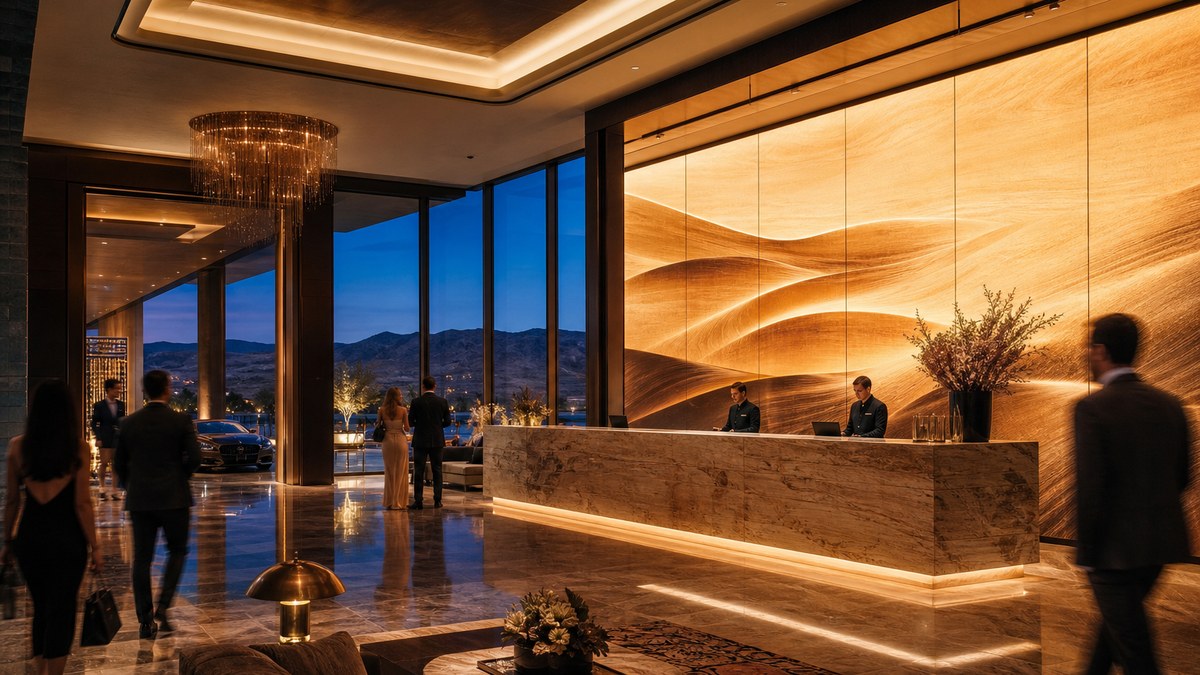
An LED video wall in Las Vegas is a large display built from direct-view LED cabinets, sized and specified for its viewing distance, its light environment and its building, and on a resort, casino or commercial project it is planned with the architecture, structure, power and data rather than bought as a product. The right wall for a hotel lobby, a casino feature wall, a retail promenade or a Strip-facing exterior differs in pixel pitch, brightness, protection, service access and permits, and getting those decisions right early is what separates a wall that looks designed from one that looks added.
Quick answer
Choose an LED video wall in Las Vegas by starting from the viewer: the closest normal viewing distance sets pixel pitch (a common rule of thumb is about ten feet of viewing distance per millimeter of pitch), the light environment sets brightness, and indoor or outdoor exposure sets protection and cooling. Then coordinate structure, power, data and service access with the design team, confirm the sign and building permits with the jurisdiction, and make sure the proposal names the licensed contractor who will install it.
We are a Las Vegas team that coordinates design-assist, product supply and licensed installation for large LED lighting, signage, facade and display projects, working with architecture and engineering partners and licensed, insured contracting partners. Strip projects mentioned in this article, such as Sphere, the Fremont Street Experience canopy, Resorts World Las Vegas and Fontainebleau Las Vegas, are referenced from public reporting only. We did not design, supply or build them, and we are not affiliated with those properties.
Why LED video walls are now part of the building, not the AV list
Large displays on a Las Vegas property used to be concentrated in the sportsbook and on the marquee. Today, direct-view LED shows up across the whole property: behind the front desk, wrapped around casino columns, overhead in retail promenades, along convention pre-function corridors, behind the DJ booth at a dayclub and on the podium facing the boulevard. As the walls have grown, they have moved out of the audio-visual budget and into the architecture. A wall that is twenty or thirty feet wide needs steel, dedicated power, a data path, cooling and access for service, and every one of those needs to be on the drawings before the walls are framed.
That shift changes who should be at the table. The architect and interior designer decide where the wall sits and how it meets the finishes. The lighting designer decides how it relates to the ambient light, because a bright wall in a dim lounge changes the whole room. The structural and electrical engineers size the support and the circuits. The general contractor sequences it. When the LED supplier and installer join only at bid, they inherit those decisions instead of informing them, which is the same lesson we covered for facades in the design-assist timeline for LED facade lighting.
Where LED video walls go on a Las Vegas property
Each location on a property has its own viewing distance, light level and risk profile. The table below is a planning starting point, not a specification; the real numbers come from the seating plan, the sightlines and the content.
| Location | Typical viewing | What drives the spec | Planning notes |
|---|---|---|---|
| Hotel lobby and registration | Close, guests standing and walking | Fine pitch, color accuracy, low-brightness performance | Treat as an art wall; coordinate with millwork, ceiling and ambient light |
| Casino feature walls and columns | Mixed, close to mid-distance | Curves and corners, 24/7 operation, service access without closing the floor | Plan front service where rear access is not possible |
| Sportsbook and bars | Seated, fixed sightlines | Multi-feed layout, processing, camera-friendly refresh | See our sportsbook LED video wall guide |
| Retail promenades and overhead canopies | Mid-distance, often looking up | Large area, weight, ceiling structure, daylight from skylights | Brightness and viewing angle matter more than pitch |
| Convention, ballroom and pre-function | Mid to far, audiences seated | Flexibility, inputs, sometimes rental integration | Decide permanent versus rental early |
| Pool, dayclub and nightlife | Mid to far, crowds | Weather and water exposure, show control, heat | Outdoor-rated product even under a canopy |
| Exterior podium, marquee and facade | Far, from cars and sidewalks | High brightness, sealing, wind load, sign permits | Handled as a sign; see LED signs and marquees |
What the Strip shows about video wall scale
Las Vegas has some of the largest and most visible LED displays anywhere, and they are useful benchmarks for what is possible, even though most projects are far smaller. We did not work on any of the projects below; the facts come from the public sources listed at the end of this article.
Sphere: a building that is a display
Sphere's exterior, known as the Exosphere, was first lit on July 4, 2023. Inside Lighting reported that the exterior covers about 580,000 square feet with roughly 1.2 million LED pucks, each containing 48 individual diodes, and that the interior Immersive Display Plane runs at 16K by 16K resolution. It is an extreme example of a principle that applies to every large wall: at that scale the display is part of the structure, and the structure is designed around it.
Fremont Street Experience: a canopy refreshed in phases
The Viva Vision canopy downtown was refreshed with Watchfire LED technology in sequenced phases starting in 2019. Sixteen:Nine reported a canopy about 1,500 feet long with 130,000 square feet of LED, 16.3 million pixels and 49 million LEDs, described as seven times brighter and four times sharper than the original. The lesson for owners is the phasing: a large display that people walk under every night was upgraded in sections rather than shut down.
Resorts World and Fontainebleau: exterior LED as the brand
Resorts World Las Vegas switched on a west tower display of about 100,000 square feet of direct-view LED with more than 3,500 cabinets on July 4, 2020, according to Sixteen:Nine. Fontainebleau Las Vegas switched on a 167-foot, three-sided marquee in March 2024. Both show how exterior video has become the face of a resort, and both are covered in more depth in our article on the biggest LED projects in Las Vegas.
Lesson: the landmark walls were planned as building systems, with structure, power, data, access and phasing designed in. The same discipline, at a smaller scale, is what makes a lobby or promenade wall succeed.
Step 1: choose pixel pitch from the viewer, not the catalog
Pixel pitch is the distance in millimeters from the center of one pixel to the center of the next. A smaller pitch packs more pixels into the same area, so the image holds together at closer distances. Planar's widely used rule of thumb is that pixel pitch multiplied by ten gives an approximate viewing distance in feet. It is a starting point, not a law: content, eyesight and how long people look all matter, and finer pitch adds cost and power without adding value if nobody stands close.
| Pixel pitch | Approximate viewing distance (10x rule) | Where it usually fits |
|---|---|---|
| Under 1.5 mm | About 15 ft or less | Lobby art walls, VIP lounges, executive briefing rooms |
| 1.5 to 2.5 mm | About 15 to 25 ft | Registration walls, casino feature walls, bars |
| 2.5 to 4 mm | About 25 to 40 ft | Sportsbooks, ballrooms, larger venues |
| 4 to 10 mm | About 40 to 100 ft | Promenade canopies, pool and dayclub screens, podium displays |
| 10 mm and above | About 100 ft and beyond | Exterior marquees and building-scale media facades |
Two refinements matter on Las Vegas projects. First, measure from the closest place people normally stand or sit, not from the middle of the room, because the guests at the front desk or the bar decide whether the wall looks crisp. Second, check the resolution the content needs. A wall that must show several live feeds at once needs enough pixels for each window, which can push the pitch finer than the distance alone suggests.
Step 2: brightness, heat and protection for the Mojave
Brightness is where indoor and outdoor walls diverge most. Indoors, the risk is too much light: a wall that is bright enough for a sunny atrium can overpower a dim casino lounge, so the wall must look good at low output with smooth grayscale. A 2026 display brightness guide from Litemax gives a sense of the spread for commercial displays: roughly 250 to 500 nits for typical indoor rooms, 500 to 700 near windows, 700 to 1,500 for shaded or semi-outdoor spaces, and 2,500 to 4,000 nits or more for direct sunlight. Outdoor LED walls in Las Vegas also need automatic dimming tied to ambient light, because a level that reads at noon is glaring at midnight.
Heat is the outdoor wall's biggest enemy
Las Vegas reached its all-time high of 120°F at Harry Reid International Airport on July 7, 2024, according to the National Weather Service as reported by AZFamily. A dark LED face in full sun runs hotter than the air around it, and electronics that run hot age faster. Ask for the manufacturer's rated operating temperature, the cooling approach (passive, fans or conditioned enclosures), how brightness is managed at high temperature, and what monitoring alerts the operator before a cabinet fails.
Sealing and ingress ratings
Ingress protection ratings under IEC 60529 describe resistance to dust and water. The first digit 6 means dust-tight; the second digit 5 or 6 means protection against water jets or powerful jets. Desert dust, monsoon storms, pool splash and pressure washing all matter here, so outdoor walls, and indoor walls near pools or misters, should carry a rating that matches the actual exposure on both the front and the rear of the cabinet.
Step 3: the LED technology and how it will be serviced
Most direct-view LED walls use surface-mount (SMD) LEDs, where each pixel's red, green and blue diodes sit in a small package on the module. Chip-on-board (COB) modules mount the diodes directly on the board and coat them in resin. Rent For Event's 2025 comparison sums up the trade-off: COB offers an impact- and dust-resistant surface and ultra-fine pitches down to about 0.7 mm, while SMD allows more granular repairs but leaves diodes exposed to damage from handling. For a lobby wall that guests can touch, or a casino column at cart height, that durability counts. For a wall that will be serviced often, repair strategy counts.
Service access deserves the same attention as pixel pitch. Rear-service walls need a maintenance corridor behind them, which costs floor area. Front-service walls let technicians remove modules from the face, which suits walls mounted tight to a structure or inside millwork, but the front-service tooling and procedure need to be part of the operator's training. On a casino floor, the right answer is the one that lets a module be swapped in minutes, at night, without barricading a gaming area.
Spare parts are part of the design. Modules from the same production batch match in color; modules ordered years later may not. A good proposal includes an attic stock of modules, receiving cards and power supplies from the original batch, stored on site. When an older wall does need parts, our LED modules and parts supply service helps source compatible components.
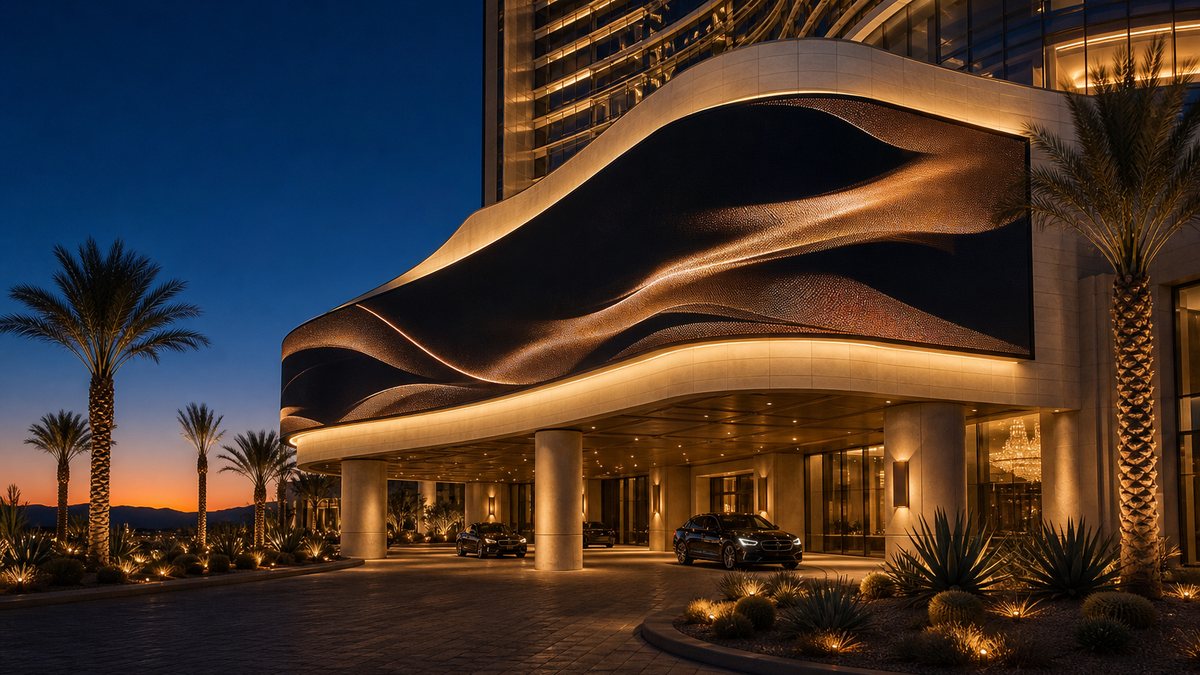
Step 4: structure, power, data and heat inside the building
An LED video wall is heavy, draws significant power and turns most of that power into heat. Those three facts make it a building system:
- Structure. The wall's weight, plus wind load outdoors, goes to the structural engineer of record. Walls hung from ceilings or cantilevered over walkways need engineered attachments and, often, seismic bracing details. Plan the support steel or backing before the wall is framed.
- Power. Size circuits for the wall's maximum rated draw, not its average, and plan where the power supplies, distribution and disconnects live. Electric signs and outline lighting fall under NEC Article 600, which requires listed equipment installed per the listing and a disconnecting means within sight of the sign; interior displays follow the electrical code that applies to their use.
- Data and control. Video processors, sending and receiving cards, fiber or copper runs and the content player need a home, usually a dedicated rack in a conditioned room with a clean path to the wall. Redundant data and power paths keep the wall running if one link fails.
- Heat. Inside the building, the wall's heat lands in the room. The mechanical engineer needs the wall's heat load to size the HVAC, especially in enclosed lounges and in millwork cavities.
- Access. Lifts, catwalks, removable panels and safe working space for service, coordinated with the ceiling and finish plans.
Lighting packages on new builds already coordinate these items for fixtures; adding the video walls to the same package, as we describe in LED lighting packages for new Las Vegas builds, keeps one team responsible for how the light and the displays work together.
Step 5: content, control and who operates the wall
The best hardware looks poor with the wrong content. Decide early what the wall will show and who will run it:
- Brand and art content for lobbies and feature walls, created at the wall's exact native resolution so nothing is scaled or cropped.
- Live and multi-feed content for sportsbooks, bars and event spaces, which drives processor and input requirements.
- Scheduled and dayparted content that changes brightness and mood across the day, so a wall that greets morning check-ins does not overpower a late-night lounge.
- Show control integration for dayclubs, nightlife and exteriors, where the wall must sync with lighting, audio and sometimes the facade, often over DMX or network protocols.
- Operations: who can change content, how remote monitoring works, and what the service response will be when a cabinet alarms at 2 a.m.
Planning an LED video wall for a Las Vegas resort, casino or commercial project?
Send the drawings, an RFP or a short description of the space and the goal. We will help define pixel pitch, brightness, structure, power and service access, and prepare a bid-ready proposal with the licensed contractor named.
Rental or permanent: two different products
Las Vegas hosts a constant calendar of conventions, launches and events, so many properties already see rental LED walls rolled in for shows. Rental and permanent walls are built for different jobs, and confusing the two is a common mistake on fixed projects.
| Question | Rental (touring) LED | Permanent (fixed-install) LED |
|---|---|---|
| Built for | Fast setup, repeated handling and transport | Years of continuous operation in one place |
| Structure | Ground-stack or flown frames, quick locks | Engineered attachment to the building |
| Service | Swap whole panels between shows | Front or rear module service, attic stock |
| Integration | Temporary power and data | Permanent circuits, disconnects, controls and monitoring |
| Best for | Conventions, launches, one-off events | Lobbies, casinos, retail, venues, exteriors |
| Permits | Event and temporary rules | Building, electrical and, for exteriors, sign permits |
A practical middle path for ballrooms and convention spaces is to build in the infrastructure: dedicated power, data, rigging points and a control position. Then a permanent wall can be added later, or rental walls can plug in quickly and safely without temporary cabling across the room.
Permits, licensing and who does what in Southern Nevada
Permits and licenses depend on where the wall is and whether it counts as a sign. These points apply across most Las Vegas-area projects, but always confirm with the authority having jurisdiction:
Jurisdiction comes first
Much of the Strip is in unincorporated Clark County, while downtown is in the City of Las Vegas, and Henderson and North Las Vegas run their own permit offices. Exterior displays visible from the street are generally treated as signs, with sign permits and zoning review through the relevant jurisdiction; interior walls are usually part of the building and electrical permits. Our guide to specifying an LED marquee sign covers the exterior sign side in more depth.
Licensed contractors install the work
Installation in Nevada requires an active license from the Nevada State Contractors Board in the right classification. Under NAC 624.200 and 624.240, C-2 covers electrical work and C-6 covers signs, and bids must fall within the licensee's monetary limit. The board's public license search lets an owner or GC confirm all three before award. Every proposal we prepare names the licensed contractor.
Sealed engineering
Structural attachments, wind loads and electrical design for large walls are prepared and sealed by licensed design professionals, either the project's engineers of record or, where the architect delegates the design, the LED team's engineers. That responsibility split is explained in our article on LED design-build, design-assist and plan-and-spec.
Energy code
In unincorporated Clark County, the 2024 IECC with local amendments took effect on January 11, 2026; the amendments exclude casino gaming areas and casino theme and entertainment elements from interior lighting power calculations, and display or accent lighting needs occupancy or time-switch control with manual override. How a given video wall is treated depends on its use and location, so confirm it with the design team and the plans examiner early.
Rule: decide early whether the wall is a sign, a building element or an event system. That one decision sets the permits, the licenses and who seals the drawings.
A Las Vegas LED video wall checklist for owners, architects and GCs
- Define the purpose: art, information, live feeds, advertising or show.
- Mark the closest normal viewing position and the main sightlines on the plan.
- Set pixel pitch from that distance and the content resolution.
- Define the light environment and target brightness range, with automatic dimming.
- Confirm indoor or outdoor exposure, IP rating and rated operating temperature.
- Choose SMD or COB and front or rear service, based on touch risk and access.
- Send weight and attachment needs to the structural engineer.
- Send maximum power draw and heat load to the electrical and mechanical engineers.
- Plan the control room, processors, data paths and redundancy.
- Confirm jurisdiction, sign versus building permit, and energy code treatment.
- Require a mock-up or factory sample review for color and finish.
- Specify attic stock, monitoring, training and a service response plan.
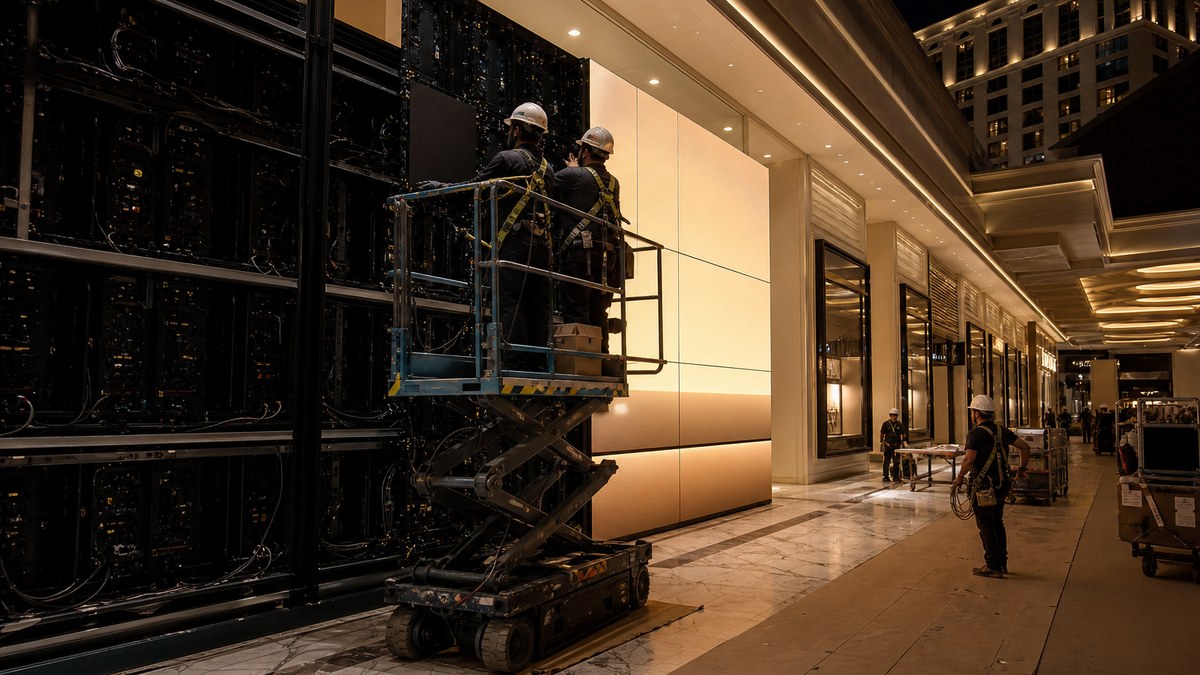
How to compare LED video wall bids
Video wall bids are hard to compare because two proposals with the same size and pitch can describe very different walls. Line them up on these points before looking at the totals:
- Same viewing assumptions: pitch, native resolution and active area, not just overall dimensions.
- Brightness and calibration: rated maximum, the planned operating range and whether the wall is calibrated for uniformity at handover.
- Environmental ratings: IP rating front and rear, operating temperature range and cooling approach for outdoor walls.
- Structure and engineering: whether support steel, attachments and sealed calculations are included or excluded.
- Power, data and processing: processors, redundancy, cabling, control room equipment and the content player.
- Service: front or rear service, attic stock quantity, monitoring, response time and warranty terms in writing.
- Licensing: the named contractor, classification and monetary limit, checked on the NSCB site.
- Exclusions: permits, general conditions, finishes around the wall, content creation and after-hours work.
We do not publish prices. Every video wall is quoted from its scope, and the useful comparison is scope against scope. For a broader look at evaluating contractors on large exterior work, see how to choose a facade lighting company in Las Vegas.
Where we fit
Las Vegas LED Lights helps owners, architects, lighting designers and general contractors plan and deliver LED video walls as part of larger lighting, signage and facade scopes. We bring 15+ years as an authorized architectural lighting dealer and project coordinator, and our licensed installation partner has completed 200+ major sports and commercial projects across the US and Canada (NFL, NBA, NHL, MLS, NCAA, NASCAR venues). Design and engineering come through our architecture and engineering partners, and installation is carried out by licensed, insured contracting partners. Learn more on our LED video walls and modules page, or see how we support hotel and casino LED lighting and architectural facade lighting on the same project.
Frequently asked questions
What pixel pitch do I need for an LED video wall in Las Vegas?
Start from the closest normal viewing distance. A common rule of thumb from Planar is pixel pitch in millimeters times ten equals the approximate viewing distance in feet, so a 2.5 mm wall suits viewers about 25 feet away. Lobby art walls often need under 2 mm, sportsbooks and ballrooms 2.5 to 4 mm, and exterior displays 10 mm or more. Content resolution can push the choice finer.
How bright should an outdoor LED video wall be in Las Vegas?
Bright enough to read in direct desert sun, with automatic dimming for night. Display industry guidance puts direct-sunlight readability at roughly 2,500 to 4,000 nits or more for commercial displays, and outdoor LED walls are usually specified with headroom above their daytime target. At night the output should drop to avoid glare for drivers, guests and neighbors.
Can an LED video wall survive Las Vegas summer heat?
Yes, if it is specified for it. Las Vegas reached 120°F on July 7, 2024, and a dark display face in sun runs hotter than the air. Ask for the rated operating temperature, the cooling method, how brightness is managed when hot, and remote temperature monitoring with alerts.
What is the difference between SMD and COB LED video walls?
SMD walls mount packaged LEDs on the module surface and allow more granular repairs, but the diodes are exposed. COB walls mount the diodes directly on the board under a resin coating, which resists impact and dust and supports very fine pitches. COB suits touchable lobby and casino walls; SMD remains common for larger pitches and many outdoor walls.
Do I need a permit for an LED video wall in Las Vegas?
Usually. Exterior displays visible from the street are generally treated as signs and need sign permits and zoning review from Clark County, the City of Las Vegas, Henderson or North Las Vegas, depending on location. Interior walls are normally covered by building and electrical permits. Confirm with the authority having jurisdiction early in design.
What license does an LED video wall installer need in Nevada?
The installing contractor needs an active Nevada State Contractors Board license in the right classification, generally C-2 for electrical work and C-6 for signs, and the bid must be within the license's monetary limit. Owners and GCs can check all three with the NSCB public license search before award.
Should we rent or buy an LED video wall for a convention or ballroom space?
Rent for occasional events and buy for daily use. Rental walls are built for fast setup and transport; permanent walls are built for years of continuous operation with engineered attachment, permanent power and monitoring. Many ballrooms build in power, data and rigging so either option can be used safely.
How early should the LED video wall be designed into a new Las Vegas project?
By schematic design for large or exterior walls, and no later than design development for interior feature walls. Weight, power, heat load, data paths and service access all affect the structural, electrical and mechanical drawings, so late decisions turn into change orders.
Can you supply replacement modules for an existing LED video wall?
Often, yes. We help source compatible LED modules, receiving cards and power supplies for existing walls and marquees, and advise when a section replacement or a full replacement is the better choice. Color matching to the existing wall is the key issue, so share the make, model and age of the wall when you ask.
How much does an LED video wall cost in Las Vegas?
We do not publish prices. Cost depends on active area, pixel pitch, indoor or outdoor rating, structure, power, processing, access, content and the service plan. Send the drawings or a description of the space and we will prepare a scoped, bid-ready proposal.
An LED video wall that looks effortless in a Las Vegas lobby, casino or exterior is the result of decisions made on the drawings long before installation. Start with the viewer, respect the desert, coordinate the building systems and insist on a named licensed contractor. When you are ready, request a bid or browse more insights.
Related
Sources
- Inside Lighting, Largest LED screen on earth lights up Las Vegas (July 2023).
- Sixteen:Nine, Watchfire wins deal for refreshed Fremont Street LED canopy (August 2018).
- Sixteen:Nine, New Vegas casino resort previews giant 100,000 sq. ft. LED facade (July 2020).
- Sixteen:Nine, 167-foot-tall, three-sided marquee switches on at Fontainebleau (March 2024).
- Planar, What is pixel pitch and why does it matter? (January 2025).
- Litemax, Outdoor display brightness guide (May 2026).
- Rent For Event, COB vs. SMD DVLED: what's the difference and why it matters (September 2025).
- EC&M, Article 600: Electric signs and outline lighting (NEC 600.3 listing, 600.6 disconnect).
- AZFamily, Las Vegas hits 120 degrees, hottest day on record (July 7, 2024, citing the National Weather Service).
- Easy-Laser, IP code and classification (IEC 60529).
- Nevada State Contractors Board, Tips for Nevada contractors; Nevada Administrative Code 624.200 and 624.240.
- Clark County, 2024 IECC local amendments (adopted July 15, 2025; effective January 11, 2026), as summarized in our LED lighting packages guide.
Las Vegas LED Lights is independent and is not affiliated with the properties, developers, contractors, organizations or manufacturers named in this article, and did not design, supply or build the projects referenced. Licensing, code and permit information is a summary for planning purposes, not legal advice; confirm requirements with the Nevada State Contractors Board, the authority having jurisdiction and your design team. All images in this article are illustrations, not photographs of real projects.